

Lithium Battery Manufacturers in Delhi for EV, Inverter and Solar Applications
The growing demand for electric mobility, reliable backup power and renewable energy storage is increasing the need for dependable lithium battery solutions. From electric rickshaws and commercial vehicles to home inverters, solar installations and industrial power systems, lithium-ion batteries are becoming an important part of modern energy infrastructure.
For businesses searching for lithium battery manufacturers in Delhi, selecting the right battery involves more than comparing prices. Battery chemistry, voltage, capacity, discharge requirements, Battery Management System (BMS), compatibility and after-sales support all influence the performance and suitability of a battery.
9AP Energy, a brand of Ambit Transmission Products Limited, offers a portfolio of lithium battery and energy storage solutions for electric mobility, backup power, telecom and industrial applications. Its product range includes e-rickshaw lithium batteries, lithium inverter batteries, wall-mounted inverter batteries, Energy Storage Systems (ESS), Battery Energy Storage Systems (BESS) and telecom lithium batteries.
Understanding these solutions can help EV businesses, dealers, solar installers, fleet operators and commercial buyers make informed purchasing decisions.
Why Choose Lithium Battery Manufacturers in Delhi?
Delhi NCR is an important market for electric vehicles, solar installations, commercial infrastructure and power backup equipment. Businesses operating in this region may need battery suppliers who understand their technical requirements, procurement schedules and application-specific challenges.
When evaluating lithium battery manufacturers in Delhi, consider the following factors.
- • Suitable battery chemistry: Confirm whether lithium iron phosphate (LiFePO4 or LFP) or another lithium chemistry is appropriate for your application.
- • Correct voltage and capacity: The battery must meet the equipment's electrical requirements and expected energy demand.
- • Smart BMS protection: Check the available protections, monitoring features and communication capabilities.
- • Product documentation: Review datasheets, operating limits, testing information and applicable certifications.
- • Manufacturing and quality processes: Ask about quality control, inspection and product traceability.
- • Technical support: Confirm access to installation guidance, troubleshooting and warranty assistance.
- • Business supply capability: OEMs, dealers and fleet operators should discuss order quantities, lead times and customization requirements.
A suitable manufacturer should help you evaluate the complete battery system instead of recommending a product based only on its advertised capacity or price.
1. E-Rickshaw Lithium Batteries for Electric Mobility
Electric rickshaws are widely used for passenger transportation and local commercial operations. Battery performance can affect vehicle availability, charging schedules and operating costs, making battery selection particularly important for drivers, fleet operators, dealers and vehicle manufacturers.
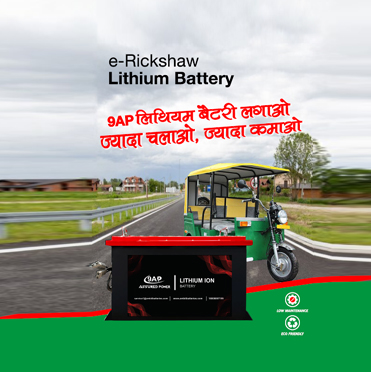
9AP Energy offers an e-rickshaw lithium battery range with listed configurations including 51.2V/105Ah, 51.2V/230Ah, 60.8V/105Ah and 64V/105Ah. The appropriate configuration depends on the vehicle design and electrical requirements.
What should you check before selecting an EV battery?
Voltage compatibility: The battery voltage must match the vehicle's motor controller and electrical system.
Capacity and energy: Ampere-hours (Ah) indicate electrical charge capacity, while watt-hours (Wh) or kilowatt-hours (kWh) help describe stored energy. For an approximate nominal energy calculation, multiply nominal voltage by capacity in Ah and divide by 1,000.
Discharge capability: The battery must support the continuous and peak current required by the motor and controller.
Charging compatibility: The charger must support the battery chemistry, voltage and specified charging limits.
BMS protection: Confirm protection against conditions such as overcharge, over-discharge, overcurrent and short circuits, as applicable to the model.
9AP Energy's EV mobility solutions describe the use of LFP cells and smart Battery Management Systems. For commercial vehicles, the actual range and service life depend on vehicle load, driving conditions, charging practices, temperature and battery maintenance.
Explore the E-Rickshaw Lithium Battery range for product configurations and further details.
2. Lithium Inverter Batteries for Home and Commercial Backup
Power interruptions can affect households, offices, retail outlets and commercial facilities. Lithium inverter batteries provide an energy storage option for backup systems when the battery and inverter are designed to work together.
Compared with conventional lead-acid batteries, suitable lithium batteries may offer lower routine maintenance requirements, compact installation options and useful cycle life. Actual benefits depend on the battery chemistry, system design and usage conditions.
How to select the right lithium inverter battery
Start by identifying the equipment that must continue operating during a power interruption. Calculate the combined load and estimate the required backup duration.
For example, the backup requirements of a home running lights, fans and a router will differ from those of an office supporting computers, networking equipment and other electrical loads.
Consider these points before purchasing:
- • Total load in watts and expected operating time.
- • Battery voltage and usable energy capacity.
- • Inverter charging profile and battery compatibility.
- • Continuous discharge limits and surge requirements.
- • Available installation space and environmental conditions.
- • BMS features, warranty coverage and technical support.
9AP Energy's product portfolio includes lithium inverter batteries and wall-mounted inverter batteries. Buyers should confirm the available models, capacity options, installation requirements and compatibility with their existing equipment before placing an order.
3. Solar Lithium Batteries for Renewable Energy Storage
Solar panels generate electricity during daylight hours, but energy demand may continue after sunset. A compatible battery storage system can store available solar energy for later use, subject to system design, generation, battery capacity and operating conditions.
Businesses searching for solar lithium battery suppliers in Delhi should evaluate the complete energy storage setup rather than choosing a battery in isolation.
Important factors for solar battery selection
Usable capacity: Estimate the energy required by essential loads during the intended backup period.
Solar charging requirements: Check the maximum charging current and power supported by the battery.
Inverter compatibility: Verify the battery voltage, charging profile and communication protocol supported by the inverter.
System configuration: Consider whether the installation is off-grid, hybrid or designed for another operating arrangement.
Safety and installation: Follow the battery manufacturer's requirements for protection, wiring, temperature and installation conditions.
LFP batteries are used in many stationary storage applications because of their thermal stability and cycle-life characteristics. However, the right battery depends on the specific project requirements and verified product specifications.
9AP Energy offers Energy Storage Solutions and Battery Energy Storage Systems for energy storage applications. Explore its Solar and Renewable Energy Solutions to understand the company's broader application focus.
4. Energy Storage Systems (ESS) and Battery Energy Storage Systems (BESS)
Larger commercial and industrial facilities may need more than a conventional inverter battery. They may require storage systems designed around higher energy demand, load management, renewable energy integration or power continuity.
Although ESS and BESS are related terms, the system configuration and project scope can differ.
- • Energy Storage Systems (ESS): Solutions for storing and managing energy according to an application's requirements.
- • Battery Energy Storage Systems (BESS): Battery-based systems that store electrical energy for later use, with associated power conversion, control and protection equipment as required by the design.
Potential applications include commercial buildings, industrial facilities, renewable energy installations and larger backup power projects.
Before selecting a system, evaluate the required power rating, energy capacity, backup duration, charging and discharging profile, site conditions, monitoring requirements and integration with existing electrical infrastructure.
For project-based requirements, buyers should discuss system sizing and integration needs with a qualified technical team. A properly designed solution must account for both the battery and the equipment connected to it.
Explore the Energy Storage Solution and Battery Energy Storage System pages for relevant product information.
5. Telecom and Industrial Lithium Battery Solutions
Telecom infrastructure, industrial equipment and communication systems may require dependable backup power to maintain essential operations during interruptions.
Battery selection for these applications involves careful attention to nominal voltage, load profile, backup duration, environmental conditions, monitoring and integration requirements.
9AP Energy lists a 48V/100Ah telecom lithium battery on its homepage. The actual suitability of this or another model should be confirmed against the equipment specifications and required backup duration.
For telecom and industrial applications, buyers should evaluate:
- • Continuous load and expected backup time.
- • Voltage requirements and discharge limits.
- • Rack, cabinet or installation-space constraints.
- • BMS monitoring and supported communication interfaces.
- • Temperature conditions and installation environment.
- • Maintenance access, warranty and service arrangements.
Industrial buyers and OEMs may also need application-specific battery packs. Customization should be based on defined electrical, mechanical and communication requirements rather than assumptions about universal compatibility.
Learn more about 9AP Energy's Industrial Solutions and IoT and Smart Battery Monitoring.
6. Understanding Battery Management Systems (BMS)
A Battery Management System is an important component of many lithium battery packs. It monitors battery conditions and helps keep operation within the system's specified limits.
Depending on the battery model, BMS functionality may include:
- • Cell voltage monitoring and balancing.
- • Overcharge and over-discharge protection.
- • Overcurrent and short-circuit protection.
- • Temperature monitoring.
- • State-of-charge estimation.
- • Communication with compatible equipment.
Not every BMS offers identical features. Buyers should check the product datasheet to understand the actual protections, monitoring functions and communication options available.
The BMS is also only one part of battery safety. Correct charging equipment, appropriate installation, suitable operating conditions and adherence to manufacturer instructions remain essential.
For businesses evaluating lithium battery manufacturers in Delhi, asking about the BMS and its documented features is a practical way to compare products beyond headline capacity.
7. How to Compare Lithium Battery Prices in Delhi
Lithium battery prices vary according to chemistry, capacity, cell quality, BMS functionality, enclosure design, operating requirements, customization and order quantity. Installation, integration and warranty arrangements may also influence the total project cost.
A lower purchase price does not automatically mean a lower lifetime cost. Buyers should compare the usable energy, operating profile, warranty conditions, maintenance needs and expected replacement requirements of the products under consideration.
To obtain a relevant quotation, provide the supplier with:
- Intended application, such as EV, inverter, solar, telecom or industrial use.
- Required voltage and capacity.
- Continuous and peak power requirements, where applicable.
- Estimated quantity and expected delivery schedule.
- Existing equipment or communication compatibility requirements.
- Installation conditions and any customization needs.
This information helps a supplier assess the requirements more accurately and recommend a suitable product configuration.
Why Consider 9AP Energy for Your Battery Requirements?
9AP Energy operates under Ambit Transmission Products Limited and presents itself as a lithium battery and energy storage solutions provider. Its published portfolio covers electric mobility, inverter backup, wall-mounted batteries, ESS, BESS and telecom battery applications.
The company also highlights manufacturing capabilities, R&D, smart BMS technology, quality assurance and application-specific solutions. These areas are relevant to businesses seeking a battery supplier for ongoing procurement or project-based requirements.
For EV businesses, solar installers, distributors, OEMs and commercial buyers, the next step is to identify the relevant product category and confirm specifications directly with the company.
Review the available product information, request the latest datasheet and clarify warranty, compatibility and supply terms before making a purchase decision.
Frequently Asked Questions
1. How do I choose lithium battery manufacturers in Delhi?
Compare battery chemistry, voltage, capacity, BMS features, product documentation, applicable certifications, warranty and technical support. Confirm that the selected battery meets your equipment's electrical requirements and intended application.
2. Which lithium battery is suitable for an e-rickshaw?
The correct battery depends on the vehicle's required voltage, capacity, motor controller, charging system, load and operating conditions. Check the vehicle manufacturer's requirements and the battery datasheet before selecting a model.
3. Can lithium inverter batteries be used with solar systems?
Yes, provided the battery, inverter and charging system are compatible. Verify voltage, charging limits, communication requirements and installation instructions before integrating a lithium battery into a solar setup.
4. What affects lithium battery prices in Delhi?
Prices depend on chemistry, capacity, cell quality, BMS features, enclosure design, customization, order quantity and warranty. Comparing documented specifications and total system requirements provides a more useful assessment than price alone.
5. Does 9AP Energy offer batteries for different applications?
9AP Energy's published portfolio includes e-rickshaw lithium batteries, lithium inverter batteries, wall-mounted inverter batteries, ESS, BESS and telecom lithium batteries. Contact the company to confirm current product availability, specifications and suitability for your application.
Contact 9AP Energy for Lithium Battery Enquiries
Choosing the right battery begins with understanding your application, energy demand and technical requirements. If you are comparing lithium battery manufacturers in Delhi for EV, inverter, solar, telecom or industrial applications, contact 9AP Energy to discuss the appropriate product category.
9AP Energy Contact Details
- • Sales: 1800 890 6299
- • Service: 1800 889 7199
- • Email: info@9apenergy.com
- • Additional email: support@9apenergy.com
- • Address: FF-34, First Floor, Plot No. 9B and 9C, Cross River Mall, CBD Shahdara, New Delhi – 110032, India
- • Website:https://9apenergy.com/
Whether you need a battery for electric mobility, backup power, renewable energy storage or a commercial project, share your voltage, capacity, application and quantity requirements with the team.
Contact 9AP Energy to request product information and discuss a lithium battery solution suited to your requirements.
Conclusion
Finding suitable lithium battery manufacturers in Delhi requires a clear understanding of the application, battery chemistry, capacity, compatibility, protection features and long-term support requirements.
From e-rickshaw lithium batteries and inverter backup to solar storage, BESS and telecom applications, each use case requires a battery configuration designed for its electrical and operating conditions.
9AP Energy offers a portfolio of lithium battery and energy storage products for these different needs. Review the relevant product pages, confirm the specifications and request technical information before making your decision.
For product enquiries, call 1800 890 6299 or email info@9apenergy.com to discuss your requirements with 9AP Energy.