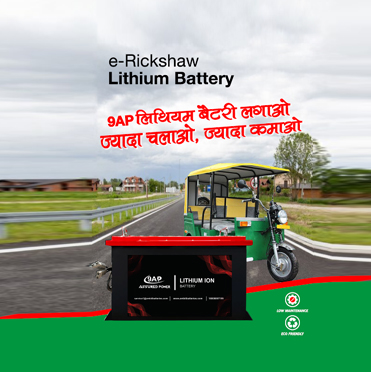


Is a Lithium Battery Worth the Investment for an E-Rickshaw
For an e-rickshaw owner, a battery is more than a vehicle component. It is a major operating expense that affects daily earnings, charging schedules, vehicle availability, and long-term profitability. Choosing the wrong battery can mean more frequent replacements, longer charging downtime, and higher maintenance expenses.
This is why many drivers and fleet operators are considering lithium-ion batteries as an alternative to conventional lead-acid batteries.
But is a lithium battery worth the investment for an e-rickshaw? The answer depends on the initial purchase price, expected battery life, daily distance, charging requirements, and the cost of keeping the vehicle on the road.
Understanding these factors can help buyers make a better financial decision. This guide explains how lithium batteries work in commercial e-rickshaws, how to calculate their long-term value, and what to check before investing in a battery from a manufacturer such as 9AP Energy.
Is a Lithium Battery Worth It for an E-Rickshaw?
A lithium battery can be a worthwhile investment for an e-rickshaw when its service life, usable energy, charging characteristics, and maintenance requirements justify the higher upfront price.
For commercial drivers, the important question is not simply which battery costs less today. It is which battery provides suitable performance at a reasonable total cost throughout the ownership period.
Lithium iron phosphate (LiFePO4 or LFP) batteries are used in electric mobility applications because of their cycle-life characteristics and thermal stability. When properly designed and matched to the vehicle, they can support repeated daily charging and discharging.
The investment becomes more attractive when:
- • The e-rickshaw operates regularly for commercial purposes.
- • Battery downtime affects daily income.
- • Lower routine maintenance is a priority.
- • The owner intends to keep the vehicle for several years.
- • The battery's usable capacity and warranty meet the application requirements.
However, a lithium battery is not automatically the right choice for every vehicle. Its price, specifications, compatibility, and expected operating conditions must be evaluated together.
Lithium vs Lead-Acid Battery for an E-Rickshaw
Both battery technologies can power electric rickshaws, but they differ in weight, charging behaviour, maintenance, usable capacity, and lifetime cost.
|
Comparison factor |
Lithium-ion battery |
Lead-acid battery |
|---|---|---|
|
Initial purchase price |
Generally higher |
Generally lower |
|
Weight for comparable energy |
Usually lighter |
Usually heavier |
|
Routine maintenance |
Generally lower |
Depends on battery design |
|
Charging characteristics |
Can support faster charging when specified for it |
Often requires longer charging |
|
Cycle life |
Depends on chemistry and operating conditions |
Depends on battery type and usage |
|
Battery monitoring |
Can include an integrated BMS |
Depends on the battery system |
|
Long-term cost |
May be lower with suitable usage |
May be attractive for limited budgets or shorter use |
The key difference is the relationship between purchase cost and useful service life.
A low-cost battery may become expensive if it needs replacement sooner. A more expensive lithium battery may provide better value if it remains reliable over a longer period and reduces other ownership expenses.
The comparison should always use batteries with appropriate voltage, usable capacity, and performance for the same vehicle application.
How Lithium Battery Technology Affects E-Rickshaw Performance
Understanding battery specifications helps explain why two batteries with different prices may deliver different results.
1. Battery chemistry and cycle life
LFP batteries are an important option for commercial electric mobility. Their cycle-life performance makes them suitable for applications involving repeated charging and discharging.
However, battery life is not determined by chemistry alone. Cell quality, depth of discharge, temperature, charging practices, and battery management all affect long-term performance.
Ask the manufacturer for the rated cycle life, the conditions under which it was measured, and the warranty terms. A cycle-life figure should not be treated as a guaranteed number of years.
2. Voltage and capacity
Battery voltage must match the vehicle's electrical system. Capacity, measured in ampere-hours (Ah), indicates the amount of electrical charge a battery can store.
The relationship between nominal voltage and capacity gives an approximate indication of energy:
Nominal energy (kWh) = Voltage × Capacity (Ah) ÷ 1,000
For example, a 51.2V, 105Ah battery has a nominal energy of approximately 5.38kWh.
This is not the same as guaranteed usable energy or driving range. Actual range depends on the battery's usable capacity, motor efficiency, vehicle load, traffic, road conditions, and driving style.
A larger battery may support longer operation, but it also needs to be evaluated for cost, weight, available space, and vehicle compatibility.
3. Battery Management System (BMS)
The Battery Management System is a critical part of a lithium battery pack. Depending on its design, it monitors battery conditions and helps protect the cells against operating conditions such as overcharging, excessive discharge, overcurrent, and abnormal temperatures.
A suitable BMS helps support safe, consistent battery operation. Some systems also provide battery status information and communication with compatible equipment.
For commercial buyers, it is worth checking which protection functions are included, whether monitoring is available, and how battery faults can be diagnosed.
4. Charging time and charger compatibility
Charging time affects how quickly an e-rickshaw can return to service. A lithium battery may support faster charging than a comparable lead-acid system, but this depends on its approved charging current, capacity, temperature, and charger.
Never assume that every lithium battery supports fast charging. Using an incompatible charger can damage the battery or create a safety risk.
Before upgrading, confirm the battery's charging voltage, current limits, connector arrangement, and compatibility with the vehicle's electrical system.
What Lithium Battery Options Does 9AP Energy Offer?
9AP Energy, from Ambit Transmission Products Pvt. Ltd., offers lithium battery solutions for electric mobility and other power applications.
Its published e-rickshaw battery range includes the following configurations:

51.2V / 105Ah
A battery configuration to evaluate for compatible e-rickshaw applications.

51.2V / 230Ah
A higher-capacity configuration to assess for suitable applications requiring more stored energy.

60.8V / 105Ah
For vehicles whose electrical architecture supports this voltage and capacity.

64V / 105Ah
An additional configuration for compatible vehicle platforms.
These configurations are listed on the 9AP Energy e-rickshaw product page. Actual suitability depends on the vehicle, motor controller, charger, installation requirements, and product datasheet.
Explore 9AP Energy's e-rickshaw lithium batteries
When selecting a battery, provide the vehicle model, existing battery voltage, daily driving distance, typical load, and charging routine. This allows the correct configuration to be identified rather than choosing solely by Ah capacity.
How to Calculate the Return on Investment of an E-Rickshaw Lithium Battery
The best way to decide whether a lithium battery is worth its price is to calculate the total cost of ownership (TCO).
Consider this simplified example.
|
Expense over a chosen ownership period |
Lithium option |
Lead-acid option |
|---|---|---|
|
Initial battery purchase |
₹35,000 |
₹20,000 |
|
Additional battery replacement |
₹0 |
₹20,000 |
|
Total battery purchase cost |
₹35,000 |
₹40,000 |
Illustrative figures only. These are not 9AP Energy quotations or predictions of battery replacement schedules.
In this example, the lithium battery costs ₹15,000 more initially. If the lead-acid alternative requires one additional replacement during the same period, the lithium option costs ₹5,000 less in battery purchases.
The actual result could be different. Charging costs, maintenance, downtime, financing, warranty claims, and the service life of each battery should also be considered.
Use this formula:
Total cost of ownership = Initial purchase + Replacement costs + Charging costs + Maintenance + Other ownership expenses
Then calculate:
Net savings = Total cost of the alternative battery system − Total cost of the lithium battery system
For commercial operators, the value of reduced downtime may also matter. If a vehicle is unavailable for work because of charging or battery problems, the resulting loss of income can be an important business expense.
Use realistic quotations and documented battery specifications rather than assuming a fixed payback period.
Is a Lithium Battery a Good Investment for E-Rickshaw Owners in Delhi?
For drivers in Delhi and the wider NCR region, daily usage, traffic conditions, operating hours, and charging access all influence battery economics.
A lithium battery may be worth evaluating if your e-rickshaw operates for long hours, is used frequently, or needs to remain available for commercial work.
Before purchasing, consider these practical factors:
- • Daily distance: Estimate the energy needed for your usual routes.
- • Vehicle load: Passenger or cargo loads influence energy consumption.
- • Charging access: Confirm whether the available charging schedule suits the battery.
- • Compatibility: Verify voltage, controller, charger, connectors, and installation space.
- • After-sales support: Check warranty terms, service availability, and the process for reporting faults.
Avoid selecting a battery based only on advertised kilometres per charge. Real-world range varies with load, driving habits, road conditions, temperature, and the overall efficiency of the vehicle.
How to Choose the Right E-Rickshaw Lithium Battery
Before making an investment, evaluate the complete battery system.
- Confirm the specifications. Match the battery voltage and capacity to the vehicle's requirements.
- Check the chemistry. Understand whether the battery uses LFP or another lithium-ion chemistry.
- Review the BMS. Ask which protection and monitoring features are included.
- Verify the charger. Ensure the charging equipment is approved for the battery.
- Read the warranty. Understand the duration, coverage, exclusions, and service conditions.
- Compare lifetime cost. Consider purchase price, expected replacement frequency, charging, maintenance, and downtime.
- Choose a credible supplier. Look for clear documentation, technical guidance, and responsive after-sales support.
These checks help prevent compatibility problems and make the investment decision more informed.
Frequently Asked Questions
1. Is a lithium battery worth the extra cost for an e-rickshaw?
It can be worthwhile when its usable capacity, service life, lower maintenance requirements, and operating benefits justify the higher upfront price. Compare total ownership costs for the expected period of use.
2. How long does a lithium battery last in an e-rickshaw?
Battery life depends on cell chemistry, quality, temperature, depth of discharge, charging practices, and operating conditions. Check the manufacturer's rated cycle life and warranty instead of relying on a universal lifespan estimate.
3. What is the price of a lithium battery for an e-rickshaw in India?
The price depends on voltage, capacity, chemistry, BMS features, manufacturer, and warranty. Request a current quotation for the specific configuration required by your vehicle.
4. Is lithium better than lead-acid for an e-rickshaw?
Lithium batteries can offer lower routine maintenance, higher energy density, and longer cycle-life potential. Lead-acid batteries generally have a lower initial purchase price. The right choice depends on the vehicle's requirements and total cost of ownership.
5. Can I replace my lead-acid e-rickshaw battery with a lithium battery?
An upgrade may be possible, but voltage, charger, controller, wiring, connectors, battery dimensions, and installation requirements must be checked. Consult a qualified technician or the vehicle manufacturer before replacing the battery.
Conclusion: Make a Smarter E-Rickshaw Battery Investment
A lithium battery can provide long-term value for e-rickshaw owners who need dependable daily operation, lower routine maintenance, and an appropriate balance between battery cost and useful service life. However, the investment should be based on the complete operating picture—not just the purchase price.
Compare lithium and lead-acid batteries using realistic costs, check compatibility, and review the product's specifications and warranty before making a decision.
Looking for an e-rickshaw lithium battery solution? Explore the product range from 9AP Energy and contact the team to discuss your vehicle's requirements.
9AP Energy — Contact details
- • Email: support@9apenergy.com | info@9apenergy.com
- • Phone: 1800 890 6299 | 1800 889 7199
- • Address: FF-34, First Floor, Plot No. 9B and 9C, Cross River Mall, CBD Shahdara, New Delhi – 110032, India
- • Product range: E-Rickshaw Lithium Batteries
Share your vehicle model, current battery specifications, and typical daily usage to help identify a suitable battery configuration.
Choose based on compatibility, safety, documented performance, and lifetime value—not just the lowest initial price.