

Can a 9AP Lithium Battery Be Used With Any Solar Inverter
Solar power systems are changing rapidly. As homeowners, businesses and industries move from traditional lead-acid batteries to lithium energy storage, one technical question is becoming increasingly important:
Can a lithium battery be used with any solar inverter?
The answer is no—not automatically.
A lithium battery can work efficiently with a suitable solar inverter, but the battery and inverter need to match in terms of voltage range, charging parameters, current requirements and, where applicable, BMS communication.
For customers considering a 9AP lithium battery for a solar system, this compatibility check is particularly important. 9AP Energy offers multiple lithium battery configurations for inverter and energy-storage applications, including 12.8V/105Ah, 25.6V/105Ah, 48V/105Ah and 51.2V/105Ah options, along with larger ESS and BESS solutions.
The right combination depends on the inverter, connected load, required backup time and intended application.
Can a Lithium Battery Work With Any Solar Inverter?
Not every inverter is designed to operate with every lithium battery.
A solar inverter does more than convert electrical energy. In a battery-based system, it also manages charging, discharging and energy flow. The battery must therefore operate within the electrical limits supported by the inverter.
Before connecting a lithium battery with a solar inverter, check:
- • Battery nominal voltage
- • Inverter battery voltage range
- • Battery capacity in Ah and kWh
- • Maximum charging current
- • Maximum discharge current
- • Recommended charging voltage
- • Low-voltage and high-voltage limits
- • Battery chemistry
- • BMS requirements
- • CAN, RS485 or other communication requirements
- • Inverter lithium-battery settings
A battery should never be selected simply because its advertised voltage appears similar to the inverter's battery rating.
What Makes a Solar Inverter Compatible With a Lithium Battery?
There are four major areas to evaluate when checking solar inverter lithium battery compatibility.
1. Voltage Compatibility
Voltage is the first and most important consideration.
9AP Energy's lithium inverter battery portfolio covers different voltage configurations for different applications. The appropriate battery voltage must match the inverter's supported battery input range.
For example, a system designed around a 12V-class battery should not simply be connected to a 24V or 48V battery. Likewise, a 48V-class inverter requires a battery configuration appropriate for its specified operating range.
The important point is to compare the actual battery operating voltage range with the inverter's specifications—not just the nominal voltage printed on the battery.
2. Charging Parameters
Lithium batteries have different charging requirements from traditional lead-acid batteries.
A compatible solar inverter or inverter-charger should be capable of providing appropriate charging parameters for the battery chemistry and manufacturer's specifications.
Important settings may include:
- • Bulk charging voltage
- • Absorption voltage
- • Maximum charging current
- • Low-voltage cut-off
- • Recharging voltage
- • Charging temperature limits
LiFePO4 batteries, for example, require charging parameters appropriate to lithium iron phosphate chemistry.
Incorrect charging settings can affect battery performance, usable capacity and service life.
3. Battery Management System
A lithium battery normally incorporates a Battery Management System (BMS) to monitor and protect the battery pack.
Depending on the battery design, the BMS can monitor parameters such as:
- • Cell voltage
- • Pack voltage
- • Current
- • Temperature
- • State of Charge (SoC)
- • State of Health (SoH)
- • Cell balancing
- • Protection status
The BMS is particularly important because lithium battery systems need controlled operating limits.
For this reason, lithium battery inverter compatibility should include both electrical compatibility and appropriate battery-management integration.
4. Communication Between Battery and Inverter
Modern lithium energy-storage systems can use communication protocols such as CAN, RS485 or UART, depending on the battery and inverter configuration.
Communication allows compatible equipment to exchange information about battery operating conditions and limits.
For advanced installations, this can help the inverter make better charging and discharging decisions based on battery information.
However, communication requirements vary between battery and inverter models. Therefore, always verify the supported protocol, pin configuration and communication settings before installation.
Can I Use a 9AP Lithium Battery With My Existing Solar Inverter?
In many cases, a compatible existing inverter can be used, but it should be checked before replacing the battery.
If you currently have a solar or inverter system and want to replace a lead-acid battery with lithium, check:
- What battery voltage does the inverter require?
- Does the inverter support lithium batteries?
- Is the charging voltage configurable?
- What is the maximum charging current?
- What is the inverter's acceptable battery voltage range?
- Does the inverter support BMS communication?
- If communication is required, does it support the battery's protocol?
- Does the battery capacity match your expected load and backup requirement?
9AP Energy's own solar-battery guidance similarly emphasizes matching battery voltage with the inverter or charge controller and selecting the configuration according to system size.
This means an existing inverter should be evaluated model by model, rather than assuming that every inverter will work with every 9AP battery.
Which 9AP Lithium Battery Is Suitable for a Solar System?
The right 9AP battery depends on the electrical architecture of the solar or backup system.
12.8V / 105Ah Lithium Battery
A 12.8V/105Ah battery is suitable for applications built around a 12V-class battery system.
It can be considered for smaller backup requirements where the inverter or energy-storage system is designed for this voltage configuration.
25.6V / 105Ah Lithium Battery
A 25.6V/105Ah configuration is intended for 24V-class systems.
Moving to a higher system voltage can be useful for applications requiring greater power while keeping current levels more manageable.
48V / 105Ah Lithium Battery
48V-class lithium batteries are commonly relevant to larger inverter and solar-storage systems.
They can be considered for applications where the inverter is specifically designed for a 48V-class battery bank.
51.2V / 105Ah Lithium Battery
The 51.2V/105Ah configuration is another higher-voltage option within 9AP Energy's portfolio.
It can be considered for appropriate solar, inverter and energy-storage applications where the inverter's battery input specifications match the battery's operating range.
The key principle is simple:
Choose the battery according to the inverter architecture, load requirement and energy-storage requirement—not simply according to Ah capacity.
Can LiFePO4 Batteries Work With Solar Inverters?
Yes. LiFePO4 batteries can be used with compatible solar inverters.
Lithium iron phosphate is widely used in stationary energy-storage applications because it provides a combination of energy-storage capability, stable chemistry and long-term cycling potential.
For solar applications, LiFePO4 batteries can be used in:
- • Residential solar backup
- • Rooftop solar storage
- • Hybrid solar systems
- • Off-grid solar systems
- • Commercial backup
- • Industrial energy storage
- • Renewable-energy storage
9AP Energy's solar and inverter battery content positions its lithium solutions around solar backup, residential applications, commercial requirements and larger energy-storage systems.
However, the chemistry alone does not determine compatibility. The inverter still needs to support the battery's voltage and charging requirements.
Can Lithium Batteries Replace Lead-Acid Batteries in Solar Systems?
A lithium battery can be an alternative to lead-acid storage in many applications, but replacing one technology with another should be treated as a system-design decision.
Lithium batteries can provide several practical advantages:
- • Higher usable energy potential
- • Lower routine maintenance
- • Faster charging capability in suitable systems
- • Integrated BMS protection
- • Compact installation options
- • Lower weight than comparable lead-acid configurations
- • Better suitability for frequent cycling in appropriate applications
9AP Energy also offers wall-mounted lithium battery configurations designed to save installation space while providing a modern alternative to conventional inverter batteries.
However, the inverter, charger, battery and protection system must still be correctly matched.
How to Check Lithium Battery and Solar Inverter Compatibility
If you are trying to determine whether a particular inverter can work with a 9AP lithium battery, use this five-step approach.
Step 1: Check the inverter voltage
Find the inverter's battery voltage specification.
It may specify a 12V, 24V, 48V or another battery configuration.
Step 2: Check the lithium battery voltage
Compare the inverter requirement with the selected 9AP battery's nominal and operating voltage.
Step 3: Check charging specifications
Compare the inverter's charging capability with the battery manufacturer's recommended charging parameters.
Step 4: Check BMS communication
If the inverter requires battery communication, confirm whether the battery supports the required communication protocol and configuration.
Step 5: Check the complete system
Finally, consider:
- • Solar panel capacity
- • Inverter output
- • Connected load
- • Daily energy consumption
- • Required backup duration
- • Battery capacity
- • Installation environment
- • Future expansion requirements
This approach is much more reliable than selecting a battery based only on price or Ah rating.
What About Hybrid and Off-Grid Solar Inverters?
Lithium batteries are particularly relevant to hybrid and off-grid solar systems because these systems often depend on stored energy when solar generation is unavailable.
A hybrid system may combine:
Solar panels + inverter + lithium battery + grid
An off-grid system may operate around:
Solar panels + inverter + lithium battery + connected loads
In both cases, the battery and inverter must be properly matched.
For larger commercial requirements, the solution may move beyond an individual inverter battery toward an Energy Storage System (ESS) or Battery Energy Storage System (BESS).
9AP Energy includes both ESS and BESS within its product and solution portfolio, allowing the brand to address applications beyond residential backup.
Why Battery Sizing Matters as Much as Inverter Compatibility
Even when an inverter and lithium battery are electrically compatible, the system can still be poorly designed if the battery is undersized.
Battery selection should consider:
Energy requirement = Load × Backup duration
For example, a system supporting lights, fans, networking equipment and other essential appliances for several hours may require a very different battery capacity from a commercial facility requiring longer backup.
The battery's Ah rating should therefore be considered together with voltage to understand its approximate stored energy.
For larger solar installations, multiple battery modules or an ESS/BESS architecture may be more appropriate than a single inverter battery.
9AP Energy: Lithium Battery Solutions for Solar and Energy Storage
9AP Energy provides a broader lithium battery portfolio rather than focusing on only one battery configuration.
Its product range includes:
- • Lithium Inverter Batteries
- • Wall-Mounted Inverter Batteries
- • Energy Storage Solutions (ESS)
- • Battery Energy Storage Systems (BESS)
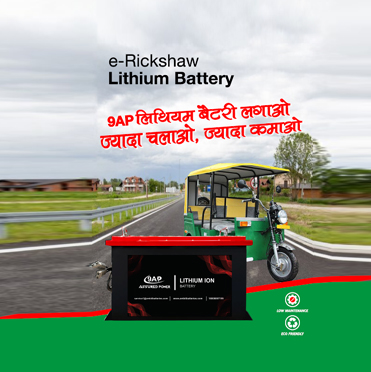
- • E-Rickshaw Lithium Batteries
- • Telecom Lithium Batteries
The company also highlights R&D, Smart BMS technology, manufacturing capabilities and solar and renewable-energy solutions as part of its overall positioning.
For customers in Delhi and across India, this makes it possible to approach battery selection according to the actual application instead of treating every solar system as the same.
Frequently Asked Questions
1. Can a lithium battery be used with any solar inverter?
No. A lithium battery must be compatible with the inverter's voltage range, charging parameters, current limits and, where required, BMS communication protocol.
2. Can I use a 9AP lithium battery with my existing inverter?
It depends on the inverter model and battery configuration. Check the inverter's battery voltage, charging settings, current limits and communication requirements before installation.
3. Do lithium batteries need a special solar inverter?
Not necessarily. Many modern solar and hybrid inverters are designed to support lithium batteries. The important factor is whether the inverter's specifications match the selected lithium battery.
4. Can a 48V lithium battery work with a solar inverter?
Yes, if the solar inverter is designed for the battery's voltage range and supports its charging, discharging and BMS requirements. A 48V-class battery should not be connected to an incompatible inverter simply because both are labelled “48V.”
5. Can LiFePO4 batteries be used for solar energy storage?
Yes. LiFePO4 batteries are suitable for many solar and energy-storage applications when correctly integrated with a compatible inverter, charger and protection system.
Conclusion
So, can a 9AP lithium battery be used with any solar inverter?
No. The correct approach is to match the battery and inverter as a complete energy-storage system.
Voltage, battery capacity, charging parameters, current limits, BMS functionality and communication protocols all influence compatibility.
For smaller systems, 12.8V and 25.6V battery configurations may be relevant. Higher-voltage 48V and 51.2V configurations can serve appropriate larger inverter and energy-storage applications, while ESS and BESS solutions can address more demanding commercial and industrial requirements.
If you are planning a solar installation, upgrading an existing inverter battery or replacing a lead-acid battery with lithium, do not select a battery based only on Ah capacity or price.
Talk to 9AP Energy
For help selecting the appropriate lithium battery for your solar inverter, share your inverter model, battery voltage requirement, connected load, required backup duration and application with the 9AP Energy team.
9AP Power
Email: support@9apenergy.com | info@9apenergy.com
Sales: 1800 890 6299
Service: 1800 889 7199
Address: FF-34, First Floor, Plot No. 9B and 9C, Cross River Mall, CBD Shahdara, New Delhi - 110032, India
Whether you need a lithium battery for a solar inverter, wall-mounted inverter battery, solar energy storage solution, ESS or BESS, 9AP Energy can help you evaluate the appropriate battery configuration for your application.