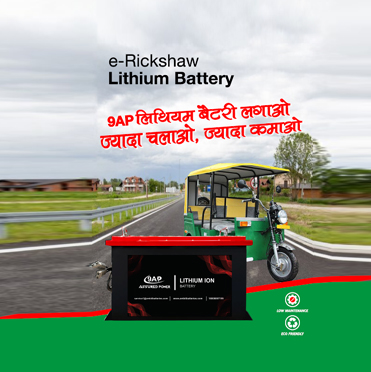


How Long Does a Lithium Battery Last in an Electric Rickshaw
A quality LiFePO4 (LFP) lithium battery in an electric rickshaw lasts 3 years, or roughly 1200-1500+ charge cycles, before capacity drops below 80%. This is 3–4 times longer than a lead-acid battery, which typically needs replacement every 8–12 months. Actual lifespan depends on the BMS quality, depth of discharge, charging habits, load, and ambient temperature.
India now has over 1.5 million electric rickshaws on the road, and the battery is the single biggest factor in how much an owner earns and spends over the vehicle's life. This guide explains exactly what determines e-rickshaw lithium battery lifespan, how it compares to lead-acid, what 9AP Energy's LFP packs deliver, and how to make your battery last as long as possible.
Key Stats at a Glance
E-Rickshaw Lithium (LFP) Battery - Quick Facts
- • Typical lifespan: 3 years under normal commercial use
- • Cycle life: 1200-1500 charge cycles before capacity falls below 80%
- • Charging time: 3–4 hours (0.25C) or under 1 hour to 80% with 2C fast charging
- • Range per charge: 80–105 km for normal load
- • Weight: As low as ~13 kg vs 40–45 kg for an equivalent lead-acid battery
- • Enclosure protection: IP67 (dust-tight, waterproof to 1m) on 9AP Energy packs
- • Warranty: 3-year limited warranty or 1200-1500 cycles, whichever comes first
What Determines the Lifespan of an E-Rickshaw Lithium Battery?
Battery life isn't a fixed number - it's the outcome of chemistry, engineering, and daily habits working together. Here are the five factors that matter most:
1. Cell Chemistry and Cycle Life
LiFePO4 (LFP) is the chemistry of choice for Indian e-rickshaws because it is thermally stable and tolerates deep, repeated cycling. Premium LFP cells - such as the EVE and High Star cells used in 9AP Energy packs - are rated for 1200-1500 full charge-discharge cycles before capacity drops below 80%, translating to roughly 3 years of typical daily use.
2. Battery Management System (BMS)
The BMS is the battery's safety brain. A military-grade BMS manages overcharge/over-discharge protection, thermal cutoff, short-circuit protection, and real-time State of Charge (SoC) and State of Health (SoH) monitoring - often via CAN 2.0B or RS485 communication for fleet-level tracking. Weak or absent BMS logic is the single biggest cause of early battery failure.
3. Depth of Discharge (DoD) and Charging Habits
Every full discharge-to-charge sequence counts as one cycle. Partial discharges (say, 20%–80%) put far less stress on the cells than running to empty every day. CC-CV (Constant Current–Constant Voltage) charging protects long-term cell health; cheap, uncontrolled chargers accelerate degradation.
4. Load and Driving Conditions
Overloading beyond the rated payload, constant stop-start traffic, and steep inclines - all common in Delhi and NCR - increase current draw and heat generation, which shortens effective battery life.
5. Enclosure Protection and Ambient Temperature
Delhi summers regularly cross 45°C. Without a sealed, IP67-rated enclosure, heat and dust ingress degrade cells faster than the rated cycle life would suggest. A fully dust-tight, waterproof-to-1-metre enclosure protects the pack through monsoon and peak summer alike.
Lithium vs Lead-Acid: Full Comparison
| Parameter | Lithium (LFP) | Lead-Acid |
|---|---|---|
| Typical Lifespan | 3 years | 8–12 months (2–4 yrs max) |
| Cycle Life | 1200-1500+ cycles | 300–500 cycles |
| Charging Time | 3–4 hrs (1C); <1 hr to 80% (2C) | 6–8 hours |
| Weight | ~13–48 kg | 40–80 kg |
| Backup at End of Life | 75–80% | ~50% |
| Maintenance | Zero - no top-up needed | Regular water top-up required |
| Range per Charge | 80–120 km (60.8V/105Ah) | 50–70 km, degrading faster |
|
Total Cost of Ownership |
Lower over 3–5 years | Higher due to frequent replacement |
9AP Energy E-Rickshaw Battery Range: Specs & Options
9AP Energy manufactures purpose-built LFP battery packs for India's e-rickshaw segment, using EVE and High Star cells with laser-welded construction inside IP67-rated CRCA steel enclosures:
| Configuration | Best Suited For |
| 51.2V / 105Ah | Standard passenger e-rickshaws - reliable daily range |
| 60.8V / 105Ah | High-load and longer-route applications |
| 64V / 105Ah | Premium e-rickshaws and cargo variants |
| 51.2V / 230Ah | Heavy-duty cargo and commercial fleet use |
All configurations ship with a 3-year limited warranty or 1200-1500 charge cycles (whichever comes first), and support 2C fast-charging for rapid shift turnaround. Full specifications: 9apenergy.com/products/e-rickshaw-lithium-battery
Total Cost of Ownership (TCO): Lithium vs Lead-Acid
Upfront price isn't the full picture. Over a 5-year operating window, a lead-acid e-rickshaw owner typically replaces the battery 4–6 times, while a lithium owner replaces it once - or not at all, if usage stays within the 1200-1500-cycle rating.
- • Fewer replacements: 1 lithium pack can outlast 4–6 lead-acid sets over the same period
- • Less downtime: Faster charging means more trips per day and higher daily earnings
- • Lower running cost per km: Higher usable capacity and efficiency reduce cost per kilometre
- • No maintenance cost: Zero water top-up or corrosion-related repairs
For most operators running 70–120 km per day, the higher upfront cost of a lithium pack is typically recovered within 18–36 months through savings on replacements and downtime.
How to Extend Your E-Rickshaw Lithium Battery Life
- • Avoid full discharge - recharge once it drops to around 20%
- • Use only manufacturer-approved CC-CV chargers
- • Park and charge in shade; avoid direct peak-summer heat
- • Schedule periodic BMS and SoH diagnostics, especially for fleet vehicles
- • Avoid overloading beyond the rated passenger/cargo capacity
- • Where possible, operate between 20–80% charge rather than 0–100% every cycle
Signs Your E-Rickshaw Lithium Battery Needs Replacement
- • Noticeably reduced range per charge compared to when new
- • Longer-than-usual charging times
- • Excessive heat during charging or under load
- • Sudden voltage drops when climbing inclines or under load
- • Frequent BMS fault alerts or warning indicators
Government Support for EV Battery Adoption
India's policy push is accelerating the shift from lead-acid to lithium in the e-rickshaw segment:
- • FAME II and PM e-DRIVE schemes offer incentives for certified electric three-wheelers
- • The PLI Scheme for Advanced Chemistry Cell (ACC) battery storage supports domestic LFP cell manufacturing
- • BIS and ICAT certification requirements are raising the safety bar for battery packs sold in India
Eligibility and subsidy structure vary by state - confirm current terms with your local RTO or dealer.
Glossary of Key Terms
- • LFP (LiFePO4): Lithium Iron Phosphate - the thermally stable lithium chemistry used in most Indian e-rickshaw batteries
- • BMS: Battery Management System - the electronics that protect and monitor the battery pack
- • DoD: Depth of Discharge - how much of the battery's capacity is used before recharging
- • SoC / SoH: State of Charge / State of Health - real-time charge level and long-term battery condition
- • IP67: An ingress protection rating meaning fully dust-tight and waterproof to 1 metre of submersion
- • CC-CV Charging: Constant Current–Constant Voltage - the standard safe charging method for lithium batteries
Why Choose 9AP Assured Power for Your E-Rickshaw Battery?
9AP Energy, part of Ambit Transmission Products Pvt. Ltd., brings three decades of manufacturing heritage to LFP battery production at ISO 9001:2015, ISO 14001:2015, and ISO 45001:2018 certified facilities in Kotdwar and Haridwar, Uttarakhand, with a combined 150 MW production capacity.
Trusted by organizations including Delhi Metro, Wipro, Microtek, Flipkart, and PepsiCo, 9AP Energy's e-rickshaw packs are engineered specifically for Indian road, load, and climate conditions.
9AP Energy - E-Rickshaw Battery Highlights
- • EVE and High Star premium LFP cells with laser-welded construction
- • Military-grade BMS with CAN 2.0B / RS485 smart monitoring
- • IP67-rated CRCA steel enclosure - dust-tight and waterproof to 1m
- • 1200-1500+ charge cycles - 5 to 10 years of typical daily use
- • 3-year limited warranty or 1200-1500 cycles, whichever comes first
- • Government-recognized R&D division with dedicated technology labs and patents
- • IoT-enabled smart battery monitoring available for fleet operators
Frequently Asked Questions
Q: How long does a lithium battery last in an electric rickshaw?
A: A quality LFP e-rickshaw battery lasts 3 years, or 1200-1500+ charge cycles, before capacity drops below 80%, assuming normal use and proper charging habits.
Q: Is a lithium battery better than lead-acid for an e-rickshaw?
A: Yes. Lithium (LFP) batteries deliver 1200-1500+ cycles versus 300–500 for lead-acid, charge in a third of the time, weigh far less, and need zero maintenance.
Q: How many kilometres does an e-rickshaw lithium battery run per charge?
A: A 60.8V/105Ah LFP pack typically delivers 80–120 km per charge under normal load, compared to 50–70 km for a comparable lead-acid battery.
Q: What is the warranty on 9AP Energy's e-rickshaw lithium batteries?
A: 9AP Energy offers a 3-year limited warranty or 1200-1500 charge cycles on its e-rickshaw LFP battery packs, whichever comes first.
Q: How can I extend my e-rickshaw lithium battery's life?
A: Avoid full discharges, use manufacturer-approved CC-CV chargers, avoid overloading, park in shade, and get periodic BMS health checks.
Q: Can I replace my e-rickshaw's lead-acid battery with a lithium one?
A: In most cases, yes - provided the voltage matches your motor controller and charging system. 9AP Energy's technical team offers free consultation for drop-in replacements.
Q: What does IP67 mean for an e-rickshaw battery, and why does it matter?
A: IP67 means the battery enclosure is fully dust-tight and can withstand submersion in up to 1 metre of water - important protection during Delhi's monsoon and dusty summer conditions.
Conclusion
A well-engineered lithium battery - built on LFP chemistry, protected by a strong BMS, and sealed in an IP67 enclosure - can keep your electric rickshaw running reliably for 5 to 10 years. That translates directly into fewer replacements, less downtime, and a lower total cost of ownership than lead-acid alternatives. Choosing a certified manufacturer with transparent cycle-life data and a real warranty is what separates a good investment from a costly mistake.
Get Assured Power for Your E-Rickshaw Fleet
- • Talk to 9AP Energy for lithium battery solutions engineered for Delhi's roads, heat, and monsoon conditions.
- • Email: info@9apenergy.com | support@9apenergy.com
- • Sales: 1800 890 6299 | Service: 1800 889 7199
- • Address: FF-34, First Floor, Plot No. 9B and 9C, Cross River Mall, CBD Shahdara, New Delhi - 110032, India
- • Explore the full range: E-Rickshaw Lithium Battery
- • Get a fleet quote today and switch to Assured Power.