

Future of Lithium Batteries in India 2027 Market Trends, EV Growth, Manufacturing and Business Opportunities
India's energy and transportation sectors are entering an important phase of transformation. Electric vehicles, renewable energy installations, industrial automation and modern backup power systems are changing how electricity is generated, stored and consumed. At the centre of this transformation is lithium-ion battery technology.
The future of lithium batteries in India is becoming increasingly important as demand grows across electric mobility, residential power backup, solar installations, telecommunications and industrial energy storage. Businesses are no longer considering batteries simply as backup equipment. They are becoming essential components of transportation, energy infrastructure and commercial operations.
As India moves towards 2027, opportunities are emerging for lithium battery manufacturers, OEMs, distributors, solar companies and industrial buyers. Government initiatives, improvements in battery technology and the expansion of electric mobility are expected to influence the industry's next stage of development.
Let's explore the major market trends, technological developments, product applications and business opportunities shaping India's lithium battery industry in 2027.
1. Lithium Battery Industry in India: Market Outlook for 2027
India's lithium-ion battery industry is expanding beyond consumer electronics and traditional automotive applications. Electric three-wheelers, electric two-wheelers, solar installations, telecom infrastructure and industrial power systems are creating demand for different battery configurations.
According to projections cited by NITI Aayog, India's annual lithium-ion battery demand could reach approximately 210 GWh by 2030. This projected growth highlights the importance of developing domestic manufacturing capabilities and strengthening the battery supply chain.
Several factors are contributing to the industry's expansion:
- • Increasing adoption of electric vehicles.
- • Growing demand for solar energy storage.
- • Expansion of e-rickshaw and electric commercial vehicle markets.
- • Rising requirements for reliable industrial backup systems.
- • Government support for domestic battery manufacturing.
- • Improvements in battery management and protection technology.
- • Growing interest in battery recycling and critical mineral processing.
In 2027, manufacturers will need to focus not only on battery capacity but also on product reliability, safety, manufacturing quality and application-specific performance.
2. Electric Vehicle Growth Will Drive Lithium Battery Demand
Electric mobility remains one of the major factors influencing the future of lithium batteries in India.
Electric vehicles require batteries that can deliver consistent power, withstand repeated charging cycles and operate reliably under different driving conditions. Lithium-ion batteries, particularly Lithium Iron Phosphate (LFP), are widely used in several EV applications because of their energy efficiency, thermal characteristics and cycle-life potential.
Growing Demand for E-Rickshaw Lithium Batteries
E-rickshaws and electric three-wheelers play an important role in India's passenger and commercial transportation network.
Their daily operating conditions involve frequent acceleration, repeated charging, variable passenger loads and extended operating hours. Therefore, selecting the right battery requires more than simply comparing voltage and capacity.
Important selection factors include:
- • Battery voltage and ampere-hour capacity.
- • LFP cell chemistry and cell quality.
- • Battery Management System (BMS).
- • Charging compatibility.
- • Enclosure protection.
- • Operating temperature and expected cycle life.
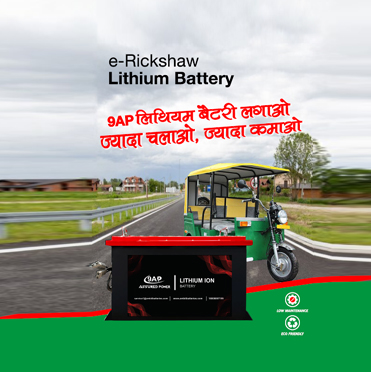
9AP Energy offers e-rickshaw lithium battery configurations including 51.2V/105Ah, 51.2V/230Ah, 60.8V/105Ah and 64V/105Ah.
These configurations address different vehicle requirements, subject to compatibility with the motor controller, charger and electrical architecture.
Explore the 9AP Energy E-Rickshaw Lithium Battery range.
Growth of Electric Two-Wheelers and Commercial EVs
Electric scooters, motorcycles, delivery vehicles and commercial electric fleets are also creating opportunities for battery manufacturers.
Fleet operators increasingly consider battery performance, charging requirements, operating costs and vehicle availability when selecting battery solutions.
This makes reliable battery design, suitable cell selection and effective BMS protection important considerations for EV manufacturers.
3. Lithium Inverter Batteries and Solar Energy Storage Will Expand
Solar energy is becoming an important part of India's electricity infrastructure. However, solar power generation does not always match electricity consumption. Energy storage allows excess electricity to be stored and used when required.
Lithium inverter batteries are becoming an option for homeowners, offices, commercial establishments and solar installations.
Compared with conventional lead-acid batteries, suitable lithium systems can offer:
- • Higher usable energy under compatible operating conditions.
- • Lower routine maintenance requirements.
- • Compact installation options.
- • Efficient charging and discharging.
- • Longer service life when properly designed and operated.
9AP Energy's product portfolio includes 12V/110Ah and 24V/110Ah lithium inverter batteries, along with wall-mounted configurations such as 12.8V/105Ah, 25.6V/105Ah and 48V/105Ah.
These products serve different backup requirements. Actual selection should depend on inverter compatibility, connected load, backup duration and charging specifications.
For residential and commercial buyers, selecting the correct lithium inverter battery can improve energy management and provide a suitable backup solution.
4. Battery Energy Storage Systems (BESS) Will Support India's Energy Transition
As renewable energy capacity increases, storing electricity becomes essential for managing fluctuations in power generation.
Battery Energy Storage Systems store electricity and supply it when required. They can support renewable energy integration, grid management, peak-demand management and commercial power backup.
India's National Electricity Plan identifies substantial future requirements for battery energy storage capacity, reflecting the growing importance of BESS in the country's electricity infrastructure.
Important applications include:
- • Commercial and industrial energy storage.
- • Solar power integration.
- • Grid-scale battery installations.
- • Renewable energy projects.
- • Critical infrastructure backup.
- • Peak-load management.
9AP Energy offers Energy Storage Solution (ESS) and Battery Energy Storage System (BESS) product categories for businesses exploring advanced energy storage applications.
These projects require proper system sizing, battery configuration, power conversion equipment, protection systems and installation planning. Technical capability is therefore as important as battery capacity.
5. LFP Battery Technology and Advanced BMS Will Shape 2027
Battery chemistry and electronic protection systems directly influence performance, reliability and safety.
Lithium Iron Phosphate (LFP) Battery Technology
LFP, also known as LiFePO4, is an important lithium battery chemistry used in electric mobility, inverter backup and stationary energy storage.
Its key characteristics include:
- • Good thermal stability.
- • Long cycle-life potential.
- • Consistent performance under suitable operating conditions.
- • Suitability for frequent charge-discharge applications.
- • Reduced reliance on nickel and cobalt compared with NMC chemistry.
These characteristics make LFP technology relevant for e-rickshaw batteries, solar storage and industrial energy applications.
Advanced Battery Management Systems
The Battery Management System acts as the electronic monitoring and protection system of a lithium battery pack.
It monitors cell voltage, current and temperature while managing important protection functions.
Depending on its design, an advanced BMS can provide:
- • Overcharge and over-discharge protection.
- • Overcurrent and short-circuit protection.
- • Temperature monitoring.
- • Cell balancing.
- • State of Charge (SoC) monitoring.
- • State of Health (SoH) monitoring.
- • Communication with compatible external equipment.
In 2027, battery monitoring, protection and system integration will remain important considerations for electric vehicles, telecom backup and industrial energy storage.
6. Telecom and Industrial Applications Will Create New Opportunities
Lithium batteries are becoming increasingly relevant beyond electric vehicles and residential applications.
Telecom infrastructure requires dependable backup power to maintain network availability during electricity interruptions.
Industrial facilities also require reliable energy storage for automation equipment, control systems, backup applications and critical operations.
9AP Energy's product portfolio includes a 48V/100Ah telecom lithium battery, alongside ESS and BESS solutions.
For industrial buyers, important purchasing considerations include operating temperature, backup duration, discharge requirements, communication compatibility, protection systems and service support.
Custom battery configurations can also be useful where standard voltage, capacity or physical dimensions do not match the equipment requirements.
7. Government Initiatives Will Influence Battery Manufacturing in India
The Indian government continues to encourage domestic battery manufacturing through policy support and investment initiatives.
One important initiative is the Production Linked Incentive Scheme for Advanced Chemistry Cell Battery Storage.
The scheme has an approved financial outlay of ₹18,100 crore and targets 50 GWh of domestic ACC manufacturing capacity.
Other important areas of government focus include:
- • Domestic battery cell production.
- • Critical mineral sourcing and processing.
- • Battery component manufacturing.
- • Battery recycling infrastructure.
- • Electric vehicle adoption.
- • Renewable energy development.
- • Research and development.
As India moves through 2027, the progress of domestic cell manufacturing and supply-chain development will be important for the long-term competitiveness of the lithium battery industry.
Businesses should follow the latest official policy announcements rather than assuming that announced manufacturing capacity has already become operational.
8. Business Opportunities for Lithium Battery Manufacturers and Distributors in 2027
The expansion of India's lithium battery market is creating opportunities throughout the industry.
Battery manufacturing: Businesses can explore battery pack assembly, customised configurations, quality testing and battery management systems.
OEM partnerships: Electric vehicle companies and equipment manufacturers require battery packs designed around their electrical and operating requirements.
Dealer and distributor networks: E-rickshaw batteries, inverter batteries and wall-mounted lithium batteries offer opportunities for regional dealers and wholesale distributors.
Solar and energy storage: Solar installers and industrial solution providers can explore lithium-based storage systems for residential and commercial customers.
Telecom and industrial supply: Businesses can develop specialised B2B relationships with infrastructure operators, factories and commercial establishments.
For companies entering this market, selecting a reliable lithium battery manufacturer is important. Product quality, technical support, manufacturing capabilities, warranty conditions and supply consistency should be evaluated before entering a business partnership.
9. What Should Businesses Look for in a Lithium Battery Manufacturer?
Not every lithium battery is suitable for every application. A battery designed for an e-rickshaw may not meet the requirements of a solar installation or industrial storage system.
Before selecting a manufacturer, businesses should evaluate:
- Battery chemistry and cell quality.
- Voltage, Ah capacity and usable energy.
- BMS protection and monitoring features.
- Charging and discharging compatibility.
- Enclosure design and environmental protection.
- Product testing and applicable certifications.
- Warranty terms and after-sales service.
- Availability of customised battery configurations.
A professional manufacturer should be able to explain the technical specifications and help customers select products according to their actual application.
Conclusion: The Future of Lithium Batteries in India Beyond 2027
The future of lithium batteries in India is closely connected to electric mobility, renewable energy, industrial power requirements and domestic manufacturing.
From e-rickshaw lithium batteries and inverter backup systems to telecom batteries and large-scale BESS projects, lithium-ion technology is becoming relevant across multiple industries.
Although challenges involving imported cells, raw materials, manufacturing costs and recycling remain, continued investment and technological development can strengthen India's battery ecosystem.
For manufacturers, OEMs, distributors and industrial buyers, 2027 is an important opportunity to understand emerging technologies, identify market requirements and build long-term business relationships.
Looking for lithium battery solutions for your business?
9AP Energy, a brand of Ambit Transmission Products Limited, offers lithium battery products for electric mobility, inverter backup, telecom and energy storage applications.
Explore the product portfolio and connect with the team to discuss your technical and commercial requirements.
Contact 9AP Energy
- • Email: support@9apenergy.com | info@9apenergy.com
- • Sales: 1800 890 6299
- • Service: 1800 889 7199
- • Address: FF-34, First Floor, Plot No. 9B and 9C, Cross River Mall, CBD Shahdara, New Delhi – 110032, India.
- • Website:https://9apenergy.com/
Frequently Asked Questions
1. What is the future of lithium batteries in India in 2027?
The Indian lithium battery industry has significant growth potential due to electric vehicle adoption, solar energy storage, industrial backup requirements and domestic battery manufacturing initiatives.
2. Which lithium battery technology is suitable for electric vehicles in India?
LFP batteries are widely used in electric mobility because of their thermal stability and cycle-life characteristics. The appropriate chemistry depends on vehicle design, performance requirements, cost and operating conditions.
3. What is driving lithium battery demand in India?
Electric vehicles, solar installations, telecom backup systems, industrial energy storage and growing renewable energy infrastructure are important factors driving lithium battery demand.
4. What is the difference between ESS and BESS?
ESS refers broadly to Energy Storage Systems. BESS specifically refers to Battery Energy Storage Systems, which use batteries to store and supply electricity.
5. How can businesses find a reliable lithium battery manufacturer in India?
Businesses should compare cell chemistry, technical specifications, BMS protection, product testing, warranty, manufacturing capabilities and after-sales support before selecting a supplier. They should also confirm compatibility with their intended application.