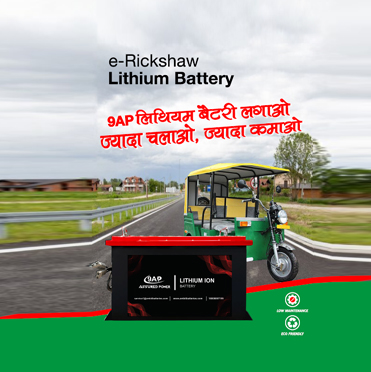


E-Rickshaw Lithium Battery Supplier in Uttar Pradesh
The shift from conventional lead-acid batteries to lithium-ion technology is changing how electric rickshaws are operated across India. For e-rickshaw owners, fleet operators, vehicle manufacturers and EV dealers, the battery is not simply a replacement component. It is a critical part of the vehicle's powertrain that influences usable energy, operating range, charging requirements, vehicle weight, maintenance and long-term operating cost.
This is why selecting the right e-rickshaw lithium battery supplier in Uttar Pradesh requires more than comparing battery prices.
Buyers should evaluate the battery chemistry, nominal voltage, Ah capacity, BMS architecture, enclosure protection, charging compatibility, communication interface, vehicle integration, warranty and technical support before making a purchase.
9AP Energy develops lithium-ion battery systems for electric mobility applications, including electric three-wheelers, commercial EVs and fleet applications. Its current e-rickshaw battery portfolio includes 51.2V/105Ah, 51.2V/230Ah, 60.8V/105Ah and 64V/105Ah configurations.
Why Lithium Batteries Are Important for E-Rickshaws
An e-rickshaw operating commercially can experience repeated charge-discharge cycles, vibration, variable loads, high ambient temperatures, stop-and-go traffic and long operating hours.
Therefore, an EV battery needs to be designed for its actual duty cycle rather than simply having a high advertised capacity.
Lithium batteries, particularly LFP or Lithium Iron Phosphate batteries, are increasingly used for electric mobility because LFP chemistry provides a combination of thermal stability, durability and suitability for repeated cycling.
For an e-rickshaw owner, the practical benefits can include:
- • Lower routine battery maintenance
- • Efficient use of stored electrical energy
- • High energy density compared with conventional lead-acid systems
- • Integrated electronic protection through BMS
- • Better suitability for repeated daily operation
- • Reduced dependence on manual battery maintenance
- • More flexible battery-pack engineering
- • Real-time battery monitoring on compatible systems
However, battery performance depends on the complete system. Cell quality, BMS configuration, thermal conditions, charger, motor controller, vehicle load and operating pattern all matter.
What Makes a Good E-Rickshaw Lithium Battery?
A professional battery buyer should look at the battery as a complete engineered system.
1. Battery Chemistry
The chemistry determines important characteristics such as energy density, thermal behaviour, cycle performance and operating requirements.
9AP Energy's EV mobility solutions use LFP chemistry cells, selected for electric mobility applications where safety, thermal stability and long operating life are important considerations.
2. Voltage
Battery voltage must match the vehicle's electrical architecture.
9AP Energy's e-rickshaw range includes:
The correct voltage should always be confirmed against the vehicle's motor controller, charger and electrical system.
3. Capacity in Ah
Ah, or ampere-hours, describes the battery's electrical capacity.
9AP Energy offers e-rickshaw configurations from 105Ah to 230Ah, allowing different battery systems to address different vehicle and operating requirements.
However, a larger Ah rating should not automatically be considered better. Battery selection should account for vehicle architecture, available installation space, payload, expected daily distance, charging availability and operating conditions.
9AP Energy E-Rickshaw Lithium Battery Range
One of the key advantages for buyers working with an established manufacturer is having multiple battery configurations rather than being restricted to a single standard pack.
9AP Energy currently lists the following e-rickshaw lithium battery configurations:
|
Battery Configuration |
Typical Application Consideration |
|---|---|
|
51.2V / 105Ah |
Standard electric three-wheeler applications |
|
51.2V / 230Ah |
Higher-capacity commercial and heavy-duty requirements |
|
60.8V / 105Ah |
Applications requiring a higher-voltage architecture |
|
64V / 105Ah |
Compatible higher-voltage e-rickshaw and commercial EV platforms |
The important point is that the correct battery should be selected according to the vehicle's electrical system and operating requirement, not simply by choosing the largest battery.
51.2V / 105Ah Lithium Battery
The 51.2V/105Ah configuration is one of the products listed in 9AP Energy's e-rickshaw battery portfolio.
The published product specifications include a nominal voltage of 51.2V, capacity of 105Ah ±1Ah, approximately 1.28 kWh energy, an IP67 enclosure and LFP prismatic cells. The product page also lists protection against short circuit, voltage, current and temperature conditions.
This type of configuration can be considered where a compatible e-rickshaw platform requires a 51.2V battery architecture
51.2V / 230Ah Lithium Battery
For applications requiring substantially greater stored capacity, 9AP Energy also lists a 51.2V/230Ah configuration.
Higher-capacity battery systems may be relevant for commercial vehicles, heavier-duty applications or operating patterns where greater onboard energy storage is required.
The final selection should still be based on vehicle compatibility, physical installation requirements, charging infrastructure and intended duty cycle.
60.8V / 105Ah and 64V / 105Ah Batteries
9AP Energy also provides 60.8V/105Ah and 64V/105Ah configurations.
These higher-voltage architectures can be relevant to compatible electric three-wheelers, cargo vehicles and other commercial EV platforms.
A higher nominal voltage should not be selected merely because the number is larger. The battery must match the motor controller, charger, wiring architecture and manufacturer's electrical specifications.
This is why technical consultation with the battery supplier is important before placing an order.
Smart BMS: The Technology Behind Battery Protection
The Battery Management System, or BMS, is one of the most important components inside a modern lithium battery pack.
The BMS continuously manages critical battery parameters and can provide protection against abnormal electrical and thermal conditions.
Depending on the configuration, functions can include:
- • Cell monitoring
- • Cell balancing
- • Overcharge protection
- • Over-discharge protection
- • Over-current protection
- • Short-circuit protection
- • Temperature monitoring
- • State of Charge monitoring
- • State of Health monitoring
- • Communication with external systems
9AP Energy states that its battery systems support communication interfaces including CAN 2.0B and RS485/UART, with additional protocol support such as Modbus and RS232 available across its battery systems.
For commercial EV operators, this type of monitoring can provide useful information about battery condition and system operation.
IP67 Protection for Real-World E-Rickshaw Applications
An e-rickshaw battery operates in an environment that can include road dust, rain, humidity, vibration and temperature variations.
For this reason, enclosure design is an important part of battery engineering.
9AP Energy's published e-rickshaw battery information includes IP67-rated enclosure protection on its battery systems.
IP protection should always be considered together with the complete battery design, including enclosure construction, sealing, connectors, cable routing and installation quality.
For commercial EV applications, environmental protection is not simply a marketing feature. It forms part of the battery's ability to operate reliably in real-world conditions.
How to Choose an E-Rickshaw Lithium Battery in Uttar Pradesh
If you are looking for an e-rickshaw lithium battery supplier in Uttar Pradesh, use a technical checklist before buying.
Check the Battery Voltage
First identify the voltage required by the e-rickshaw.
A 51.2V battery should not be substituted with a 60.8V or 64V pack simply because it has a different specification. Compatibility with the motor controller and charger is essential.
Check the Required Capacity
Consider the vehicle's:
- • Daily distance
- • Passenger or cargo load
- • Route conditions
- • Charging availability
- • Operating hours
- • Vehicle design
- • Battery installation space
Check the Cell Chemistry
Ask whether the battery uses LFP/LiFePO4 cells and request relevant product documentation.
Examine the BMS
Do not treat the BMS as a minor accessory. Ask about protection functions, monitoring capabilities and communication protocols.
Check Physical Dimensions
Battery capacity alone does not determine whether a battery will fit the vehicle.
The dimensions, mounting arrangement, connector configuration and cable routing should be checked before purchase.
Check Warranty and Technical Support
For a commercial e-rickshaw, battery downtime can affect daily operations.
Therefore, supplier support, warranty terms, service availability and technical assistance should be evaluated alongside the initial purchase price.
Why Choose 9AP Energy for E-Rickshaw Lithium Batteries?
9AP Energy operates under Ambit Transmission Products Limited, a company with a manufacturing legacy spanning nearly three decades. Its lithium-ion battery division combines manufacturing infrastructure with a government-recognized R&D centre. The company states that its production capability exceeds 500 battery packs per day.
Its EV mobility solutions are designed for:
- • Electric two-wheelers
- • Electric three-wheelers
- • Commercial EVs
- • Fleet applications
- • Manufacturing plants
The company also states that its EV battery systems use LFP cells, smart BMS technology and custom engineering for application-specific power and load requirements.
Another important consideration is customization. 9AP Energy's FAQ states that 70% of its production is custom-configured, with parameters such as voltage, capacity, dimensions, connectors and BMS parameters adjustable for specific applications.
This is particularly relevant for OEMs, fleet operators and businesses that require more than an off-the-shelf battery.
E-Rickshaw Battery Supplier vs Battery Manufacturer: Why It Matters
The terms "supplier" and "manufacturer" are often used interchangeably online, but they can represent different purchasing experiences.
A distributor may primarily handle product availability and sales, whereas working directly with a manufacturer can provide access to technical information, product engineering, application support and customization capabilities.
For an e-rickshaw fleet or OEM, the manufacturer's technical capability can become particularly important when the requirement involves:
- • Custom battery dimensions
- • Specific voltage
- • Higher capacity
- • BMS communication
- • Connector changes
- • Fleet integration
- • Vehicle-specific battery design
- • Commercial-scale supply
This is one reason businesses searching for an e-rickshaw lithium battery supplier in Uttar Pradesh should also evaluate the supplier's manufacturing and engineering capabilities.
Lithium Battery for E-Rickshaw: More Than Just Battery Price
One of the most common mistakes buyers make is comparing batteries only by purchase price.
The actual economics of an EV battery involve much more than the initial quotation.
Consider:
Initial purchase price + usable energy + charging efficiency + maintenance + expected service life + replacement frequency + downtime + warranty + technical support.
This is often referred to as the total cost of ownership (TCO).
For a commercial e-rickshaw operator, a battery that provides dependable performance and suitable service support can be more important than selecting the lowest-priced battery available.
The right comparison should therefore be between complete battery solutions rather than only between price tags.
E-Rickshaw Lithium Battery Applications in Uttar Pradesh
A reliable lithium battery solution can support different electric mobility applications, including:
- • Passenger e-rickshaws
- • Electric three-wheelers
- • Cargo e-rickshaws
- • Electric loaders
- • Commercial EVs
- • Fleet vehicles
- • Last-mile transportation
Uttar Pradesh's large urban and semi-urban markets make electric three-wheelers relevant for passenger movement, goods transportation and last-mile mobility.
For fleet operators, battery selection should additionally consider route length, daily utilization, charging schedules and vehicle turnaround requirements.
Why Local Supplier Support Matters
When purchasing an e-rickshaw lithium battery in Uttar Pradesh, technical support is an important part of the buying decision.
A professional supplier should be able to help with:
- • Battery selection
- • Voltage confirmation
- • Capacity selection
- • Charger compatibility
- • Installation requirements
- • BMS communication
- • Warranty information
- • Service support
- • Bulk requirements
- • Dealer and distributor enquiries
This becomes even more important when multiple vehicles are being operated as a fleet.
9AP Energy also provides Pan-India sales and service distributorship opportunities, which can be relevant for EV businesses looking to develop a battery distribution or service network.
Frequently Asked Questions
1. Which lithium battery is suitable for an e-rickshaw?
The suitable battery depends on the e-rickshaw's voltage architecture, motor controller, charger, required capacity, physical installation space and operating conditions. 9AP Energy currently offers 51.2V, 60.8V and 64V e-rickshaw battery configurations with different capacities.
2. What is the price of an e-rickshaw lithium battery in Uttar Pradesh?
The price depends on battery voltage, Ah capacity, cell chemistry, BMS, enclosure, connectors, warranty and other specifications. A reliable quotation should therefore be based on the exact vehicle and battery requirement rather than a generic online price.
3. Is an LFP battery suitable for an e-rickshaw?
LFP, or Lithium Iron Phosphate, is widely used in electric mobility applications because of its thermal stability and suitability for repeated charge-discharge operation. 9AP Energy uses LFP chemistry in its EV mobility battery solutions.
4. What does BMS do in an e-rickshaw lithium battery?
A Battery Management System monitors and manages important battery parameters. Depending on the battery design, it can provide cell monitoring, balancing and protection against over-charge, over-discharge, excessive current, short circuits and abnormal temperatures.
5. How do I choose an e-rickshaw lithium battery supplier in Uttar Pradesh?
Compare the manufacturer's battery chemistry, voltage and capacity options, BMS technology, enclosure protection, product documentation, warranty, technical support, service network and ability to supply batteries suitable for your specific vehicle.
Get the Right E-Rickshaw Lithium Battery from 9AP Energy
Whether you are an e-rickshaw owner, fleet operator, EV manufacturer, dealer or distributor, choosing the right lithium battery should begin with the application—not simply the price.
9AP Energy provides LFP lithium battery solutions for electric mobility, including multiple e-rickshaw configurations, smart BMS technology, application-specific engineering and commercial EV solutions.
If you are looking for an e-rickshaw lithium battery supplier in Uttar Pradesh, contact 9AP Energy to discuss your vehicle specifications, required voltage, capacity, battery dimensions and commercial requirements.
9AP Energy Sales & Support
Sales: 1800 890 6299
Service: 1800 889 7199
Email:
support@9apenergy.com
info@9apenergy.com
Address:
FF-34, First Floor, Plot No. 9B and 9C, Cross River Mall,
CBD Shahdara, New Delhi – 110032, India
For bulk orders, fleet requirements, OEM applications, dealership opportunities or technical battery requirements, speak with the 9AP Energy team.
Choose the battery based on the vehicle, the duty cycle and the application—and build your EV operation around a battery system engineered for the job