

Lithium Battery vs Lead Acid Battery-Which One Should You Choose in 2026?
If you've ever searched for the best battery for your home inverter, solar system, or electric vehicle in India, you've likely faced this critical question: lithium battery vs lead acid battery — which one is better?
With rising electricity costs in Delhi and the rapid adoption of renewable energy, choosing the right battery technology is no longer just a technical decision — it's a financial and environmental one too. In this comprehensive guide, we break down every key difference between lithium-ion batteries and lead acid batteries so you can make a confident, informed choice.
1. What is a Lithium Battery?
A lithium battery (more precisely, a lithium-ion or lithium iron phosphate battery) is an advanced rechargeable battery that stores energy through the movement of lithium ions between electrodes. The most common chemistries used in India for inverters, solar storage, and EVs are:
- LiFePO4 (Lithium Iron Phosphate) — safest, longest cycle life, ideal for home and industrial use
- NMC (Nickel Manganese Cobalt) — high energy density, used in EVs and e-mobility
- NCA (Nickel Cobalt Aluminum) — high performance, used in premium EV applications
Lithium batteries are protected by an advanced Battery Management System (BMS) that monitors temperature, voltage, current, and state of charge — making them significantly safer and smarter than traditional batteries.
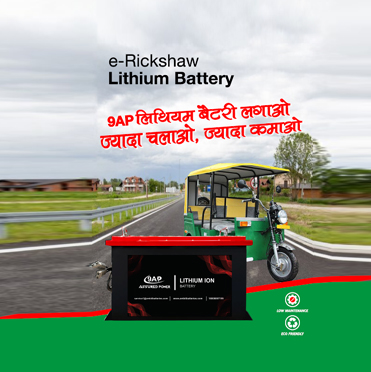
9AP Assured Power, manufactured by Ambit Transmission Products Pvt. Ltd., produces a full range of LiFePO4 and NMC lithium batteries for inverters, solar ESS, e-rickshaws, 2-wheelers, 3-wheelers, and industrial applications. With over 30 years of group legacy and an IMS-certified state-of-the-art manufacturing facility in Kotdwar, Uttarakhand, 9AP is one of India's most trusted lithium battery brands.
2. What is a Lead Acid Battery?
A lead acid battery is the oldest rechargeable battery technology, invented in 1859. It uses lead plates submerged in a sulfuric acid electrolyte to store and release energy. Common types include:
- Flooded Lead Acid (FLA) — traditional, requires regular water top-up
- Sealed Lead Acid (SLA) / VRLA — valve-regulated, maintenance-reduced
- AGM (Absorbed Glass Mat) — spill-proof, commonly used in UPS and inverters
- Gel Battery — deeper cycle capability, better for solar applications
While lead acid batteries have been the dominant choice for decades in India due to their low upfront cost, they come with significant long-term trade-offs.
3. Lithium Battery vs Lead Acid Battery: Key Differences
Before diving into detailed specs, here's a quick snapshot of how these two technologies fundamentally differ:
- Energy Storage Mechanism: Lithium-ion electrochemical intercalation vs. lead-sulfuric acid chemical reaction
- Weight: Lithium batteries are 50–70% lighter than equivalent lead acid batteries
- Efficiency: Lithium achieves 95–99% round-trip efficiency vs. 70–85% for lead acid
- Depth of Discharge: Lithium safely discharges to 80–100% DoD vs. only 50% for lead acid without damaging the battery
- Maintenance: Lithium is 100% maintenance-free; lead acid requires periodic water top-up (flooded type) and terminal cleaning
Environmental Impact: Lithium batteries are greener with a smaller carbon footprint over their lifecycle; lead acid contains hazardous lead and acid
4. Detailed Comparison Table
|
Parameter |
Lithium Battery (LiFePO4/NMC) |
Lead Acid Battery |
|---|---|---|
|
Cycle Life |
2,000 – 5,000+ cycles |
300 – 500 cycles |
|
Lifespan |
8 – 15 years |
3 – 5 years |
|
Energy Density |
150 – 250 Wh/kg |
30 – 50 Wh/kg |
|
Weight (for same capacity) |
50–70% lighter |
Heavier (baseline) |
|
Depth of Discharge (DoD) |
80–100% |
50% (recommended) |
|
Round-Trip Efficiency |
95–99% |
70–85% |
|
Charging Time |
1–4 hours |
8–16 hours |
|
Self-Discharge Rate |
1–3% per month |
5–15% per month |
|
Maintenance Required |
None |
Regular (FLA type) |
|
BMS Protection |
Yes (built-in) |
No |
|
Operating Temperature |
-20°C to 60°C |
0°C to 40°C |
|
Upfront Cost (India) |
Higher (₹8,000–₹25,000+) |
Lower (₹3,000–₹8,000) |
|
Total Cost of Ownership |
Lower (long-term) |
Higher (long-term) |
|
Environmental Impact |
Lower |
Higher (lead, acid) |
|
Safety |
High (BMS-protected) |
Moderate (acid spill risk) |
|
Applications |
Inverter, Solar, EV, Telecom, ESS |
Inverter, UPS, Automotive |
5. Energy Density & Weight
Energy density is one of the most critical metrics when comparing battery technologies, especially for space-constrained applications like home inverters and electric vehicles.
- A lithium LiFePO4 battery delivers approximately 150–200 Wh/kg of energy density
- A lead acid battery delivers only 30–50 Wh/kg
This means for the same energy storage capacity, a lithium battery is roughly 3–5 times lighter than its lead acid counterpart. For a typical 100Ah home inverter system in Delhi:
- Lead acid 12V 100Ah battery: approximately 25–30 kg
- Lithium 12V 100Ah battery: approximately 10–13 kg
For applications like e-rickshaws, 3-wheelers, and solar rooftop systems, this weight reduction directly translates to better performance, longer range, and lower structural load.
6. Lifespan & Cycle Life
This is where lithium batteries deliver the most compelling advantage over lead acid, particularly for Indian consumers dealing with frequent power cuts and daily cycling.
Lead Acid Battery Lifespan
- Typical cycle life: 300–500 full charge-discharge cycles
- Real-world lifespan: 3–5 years under normal Indian conditions
- Performance degrades significantly in extreme Delhi summer heat (45°C+)
- Sulfation and plate corrosion reduce capacity over time
Lithium Battery Lifespan
- Typical cycle life: 2,000–5,000+ cycles (LiFePO4 can exceed 6,000 cycles)
- Real-world lifespan: 8–15 years depending on usage and chemistry
- Maintains stable performance across temperature ranges with BMS protection
- No memory effect — partial charging has no adverse impact
What This Means for You
If you replace a lead acid battery every 3–4 years, you will need 3–5 replacements over the same period that a single lithium battery lasts. When factoring in replacement costs, installation charges, and downtime, lithium batteries deliver significantly lower total cost of ownership (TCO) over a 10-year horizon.
7. Charging Speed & Efficiency
In a city like Delhi where power cuts can be unpredictable, charging speed matters enormously.
- Lead acid batteries require 8–16 hours for a full charge and should not be fast-charged, as this reduces lifespan
- Lithium batteries charge in 1–4 hours and support fast charging without degradation (managed by BMS)
Additionally, lithium batteries have a round-trip efficiency of 95–99%, meaning nearly all energy stored is available for use. Lead acid batteries lose 15–30% of energy as heat during charging and discharging.
For solar energy storage systems in Delhi NCR, this means more usable solar energy harvested daily — directly reducing your electricity bill.
8. Cost Comparison in India
One of the most common reasons consumers in Delhi still choose lead acid batteries is the lower upfront price. Let's do a real-world 10-year cost analysis:
10-Year Total Cost of Ownership: 100Ah Home Inverter Battery (Delhi)
|
Cost Factor |
Lead Acid (×3 replacements) |
Lithium (×1 unit) |
|---|---|---|
|
Purchase Price |
₹5,000 × 3 = ₹15,000 |
₹18,000 |
|
Installation/Labor |
₹1,500 × 3 = ₹4,500 |
₹1,500 |
|
Maintenance (water, terminal cleaning) |
₹3,000 (10 years) |
₹0 |
|
Energy Loss (15–25% inefficiency) |
₹6,000+ in extra electricity |
₹500 (1–5% loss) |
|
Total Estimated 10-Year Cost |
₹28,500+ |
₹20,000 |
Note: Prices are approximate and vary by brand, capacity, and market conditions.
The lithium battery saves ₹8,000–₹12,000 over 10 years — plus the convenience of zero maintenance and 3× better reliability.
9. Safety & Maintenance
Lead Acid Battery Safety Concerns
- Risk of acid spills during handling or tipping
- Releases hydrogen gas during charging — requires ventilation
- Lead is a toxic heavy metal — environmental disposal concerns
- Flooded types need periodic distilled water top-up
- Terminal corrosion requires cleaning to maintain conductivity
10. Which Battery is Best for Your Application?
Home Inverter / UPS (Delhi & NCR)
✅ Recommended: Lithium (LiFePO4)
- More backup time due to higher DoD
- Charges faster between power cuts
- No maintenance in apartments and homes
- 9AP offers 12.8V–48V lithium inverter batteries from 100Ah to 400Ah
Solar Energy Storage (Rooftop Solar, Delhi)
✅ Recommended: Lithium (LiFePO4)
- Higher round-trip efficiency maximizes solar harvest
- Longer life matches solar panel warranty (20–25 years)
- Deep cycling capability — essential for off-grid solar
- 9AP Solar Battery range: 12.8V to 51.2V, 100Ah to 400Ah
11. Why 9AP Assured Power Lithium Batteries Stand Out
9AP Assured Power by Ambit Transmission Products Pvt. Ltd. is built on 30 years of group legacy with a clear mission: to provide the most advanced, reliable, and eco-friendly energy solutions for India's growing power needs.
Key Advantages of 9AP Lithium Batteries:
- IMS-Certified Manufacturing: State-of-the-art, 100,000+ sq. ft. production facility in Kotdwar, Uttarakhand — certified to ISO quality management systems
- Comprehensive Product Range: From 2-wheeler batteries to BESS (Battery Energy Storage Systems) up to 400 kWh
- Proven Track Record: Served 360+ Mega Watts of energy to 2-wheeler OEMs; supplied 40,000+ chargers to Government of India; achieved ₹400+ crore group revenue milestone
- Advanced BMS Integration: Every battery pack includes a smart BMS for protection, monitoring, and longevity
- Eco-Friendly Mission: Zero-emission, sustainable energy solutions for a greener India
- Pan-India Service Network: Nationwide service engineers for after-sales support and spare availability
Group Companies for End-to-End Support: Ambit Transmission Products Pvt. Ltd., Poonam Polymers Pvt. Ltd., Pratham International, and more
9AP Product Range Quick Reference
| Application | Voltage Range | Capacity Range |
|---|---|---|
| Home Inverter | 12.8V – 51.2V | 100Ah – 400Ah |
| Industrial Inverter/UPS | 73.6V – 720V | 100Ah – 1,400Ah |
| Lithium Power Wall | 12.8V – 51.2V | 100Ah – 400Ah |
| Telecom Battery | 48V | 25Ah – 800Ah |
| Battery Energy Storage System (ESS) | Custom Configuration | 50kWh – 400kWh |
| 2-Wheeler EV Battery | 48V – 73.6V | 30Ah – 60Ah |
| E-Rickshaw Battery | 51.2V – 60.8V | 75Ah – 100Ah |
| Cargo / Loader Battery | 51.2V – 73.6V | 200Ah – 230Ah |
FAQs – Lithium Battery vs Lead Acid Battery
Q1: Which lasts longer — a lithium battery or a lead acid battery?
Lithium batteries last significantly longer than lead acid batteries. A quality LiFePO4 lithium battery can deliver between 2,000 and 5,000+ charge cycles, providing approximately 8–15 years of service. In comparison, lead acid batteries typically offer only 300–500 cycles and usually last 3–5 years under normal Indian operating conditions.
Q2: Is a lithium battery worth the higher upfront cost in India?
Yes. Although lithium batteries have a higher initial purchase price, they offer a much lower total cost of ownership over time. With fewer replacements, zero maintenance requirements, and higher energy efficiency, lithium batteries often prove more economical over an 8–10 year period.
Q3: Can I replace my existing lead acid battery with a lithium battery?
In most cases, yes. However, it is important to ensure that your inverter or charger supports lithium battery charging profiles (CC-CV charging). Consulting a qualified technician before upgrading is highly recommended to ensure compatibility and optimal performance.
Q4: Which battery is best for home inverter use?
For home inverter applications, LiFePO4 lithium batteries are generally considered the best option. They charge faster, provide more usable backup power, offer longer service life, and require no regular maintenance, making them ideal for residential use.
Q5: Are lithium batteries safe for indoor use?
Yes. Lithium batteries, particularly LiFePO4 batteries, are among the safest battery technologies available today. They feature sealed construction, produce no harmful gas emissions during normal operation, and include an advanced Battery Management System (BMS) that protects against overcharging, overheating, and short circuits.
Q6: What is the difference between LiFePO4 and a regular lithium-ion battery?
LiFePO4 (Lithium Iron Phosphate) is a specialized type of lithium-ion battery known for its superior safety, thermal stability, and extended cycle life. Standard lithium-ion batteries, such as NMC batteries, typically offer higher energy density, while LiFePO4 batteries provide longer lifespan and enhanced safety, making them ideal for inverters and solar energy storage systems.
Q7: Which battery is better for solar panels — lithium or lead acid?
Lithium batteries are generally the preferred choice for solar energy storage. They provide higher round-trip efficiency (95–99%), deeper depth of discharge, faster charging, and significantly longer lifespan. These advantages allow solar users to maximize energy utilization and achieve better long-term value.
Conclusion
When comparing lithium battery vs lead acid battery, the advantages of lithium technology are clear for most modern applications, including home inverters, solar energy storage systems, electric vehicles, telecom infrastructure, and industrial power backup solutions.
While lead acid batteries may offer a lower upfront investment, lithium batteries provide superior long-term value through higher efficiency, longer lifespan, faster charging, enhanced safety, and virtually maintenance-free operation.
Upgrade to Smarter Energy Storage with 9AP Assured Power
Whether you need a battery for your home inverter, solar power system, electric vehicle, telecom infrastructure, or industrial application, 9AP offers reliable, high-performance lithium battery solutions designed to meet modern energy demands.
📞 Call: 1800 890 6299
📧 Email: info@ambittransmissionproducts.com
🌐 Website: www.9apenergy.com
🏢 Office: FF-34, 1st Floor, Plot No. 9B & 9C, Cross River Mall, CBD Shahdara, New Delhi – 110032
Ready to switch from lead acid to lithium? Explore the complete range of 9AP lithium batteries and experience smarter, safer, and more efficient power storage solutions.