

Can You Replace a Lead Acid Inverter Battery with Lithium
Yes, you can replace a lead acid inverter battery with lithium in many applications, but the replacement should not be treated as a simple battery swap.
The most important question is whether your existing inverter is compatible with the lithium battery's voltage, charging profile, current limits and communication requirements.
This matters because lead-acid and lithium batteries have different charging characteristics. A lithium battery, particularly a LiFePO4 battery, needs an appropriate charging strategy and battery protection system.
For homeowners, offices, shops and businesses looking to upgrade their power backup, the right approach is to check the complete system before purchasing a replacement.
At 9AP Energy, lithium battery solutions are designed for applications including inverter backup, solar energy storage, industrial power and other energy-storage requirements. The company's current product portfolio includes Lithium Inverter Batteries and Wall Mounted Inverter Batteries alongside ESS and BESS solutions.
A lead-acid inverter battery can often be replaced with lithium when:
- • The battery voltage matches the inverter.
- • The inverter supports the lithium battery's charging requirements.
- • The battery has an appropriate Battery Management System (BMS).
- • Charging and discharge current limits are compatible.
- • Required communication protocols are supported.
- • The battery capacity is correctly sized for the connected load.
If these conditions are satisfied, lithium can be a practical upgrade from traditional lead-acid or tubular batteries.
Why Are People Replacing Lead Acid Inverter Batteries with Lithium?
Lead-acid batteries remain widely used for home and commercial backup. They have a relatively low initial purchase price and are familiar to consumers.
However, users who experience frequent power cuts or cycle their batteries regularly may start looking for a more efficient alternative.
This is where a lithium inverter battery becomes attractive.
Lithium batteries can offer:
- • Longer cycle life
- • Faster charging
- • Lower maintenance
- • Higher usable capacity
- • Lower weight
- • Compact installation
- • Better energy efficiency
- • Smart battery monitoring
- • Advanced electronic protection
The important point is that lithium should be evaluated based on total ownership value, not only the purchase price.
A cheaper lead-acid battery may require multiple replacements over the period in which a quality lithium battery continues operating.
Can You Use a Lithium Battery with Your Existing Inverter?
This is the most important part of the replacement decision.
Not every inverter is automatically compatible with every lithium battery.
Before buying a lithium battery for an existing inverter, check the following specifications.
1. Inverter Battery Voltage
First, identify the DC battery voltage required by your inverter.
Common configurations include:
- • 12V
- • 24V
- • 48V
- • Higher-voltage systems for larger applications
The battery voltage must be appropriate for the inverter.
For example, an inverter designed for a 24V battery bank should not simply be connected to an incompatible battery configuration.
9AP Energy currently lists inverter lithium battery configurations including 12.8V/105Ah and 25.6V/105Ah, while its wider product portfolio includes higher-voltage battery solutions for other applications.
2. Charging Voltage and Current
Lead-acid and lithium batteries do not have identical charging requirements.
Your inverter's charger must operate within the lithium battery manufacturer's recommended charging parameters.
If the charging profile is unsuitable, it can result in:
- • Reduced battery performance
- • Battery protection shutdown
- • Incorrect charging
- • Reduced battery life
- • Possible system malfunction
This is why compatibility should be confirmed before installation.
3. Lithium Battery BMS
A quality lithium battery should have a properly designed Battery Management System.
The BMS monitors important battery parameters and can provide protection against conditions such as:
- • Overcharge
- • Over-discharge
- • Over-current
- • Short circuit
- • Excessive temperature
- • Cell imbalance
The BMS is effectively one of the most important electronic protection layers inside a lithium battery.
4. Communication Compatibility
Advanced battery systems may communicate with the inverter.
Depending on the application, this can involve:
- • CAN
- • RS485
- • UART
- • Modbus
- • Other proprietary communication protocols
9AP Energy states that its battery systems support CAN 2.0B and RS485/UART, with additional communication options available for applicable configurations.
Therefore, when upgrading an existing inverter, the battery and inverter should be evaluated as a complete system.
Do You Need to Replace Your Existing Inverter?
Not always.
If your existing inverter supports the required lithium battery voltage and charging parameters, a lithium battery replacement may be possible.
However, older inverters can have charging profiles designed specifically for lead-acid batteries.
In such cases, you may need:
- A compatible lithium battery with suitable operating parameters.
- An inverter configuration that supports lithium.
- A compatible inverter upgrade.
- A battery-inverter communication interface where required.
The safest approach is to provide the exact inverter model and existing battery specifications to a qualified battery supplier before purchasing.
Lithium vs Lead Acid Inverter Battery
The decision is not simply about which technology is “better.” It depends on how the battery will be used.
|
Feature |
Lithium Inverter Battery |
Lead Acid Battery |
|---|---|---|
|
Maintenance |
Very low |
Higher |
|
Weight |
Generally lighter |
Heavier |
|
Charging |
Generally faster |
Generally slower |
|
Cycle life |
Generally higher |
Generally lower |
|
Usable capacity |
Generally higher |
More limited |
|
Installation footprint |
Compact options available |
Usually larger |
|
Initial purchase cost |
Higher |
Lower |
|
Long-term replacement requirement |
Lower in many applications |
Typically higher |
|
Monitoring |
Smart BMS available |
Limited depending on battery |
|
Technology |
Lithium-ion/LiFePO4 options |
Lead-acid/tubular |
The correct choice should consider backup requirement, cycling frequency, available space, budget, installation environment and expected service life.
Why LiFePO4 Is Popular for Inverter Applications
When people search for a LiFePO4 inverter battery, they are generally looking for lithium iron phosphate chemistry.
LiFePO4 is widely used in stationary energy storage because it offers a combination of:
- • Good thermal stability
- • Long cycle life
- • Reliable repeated cycling
- • High usable capacity
- • Low maintenance
- • Suitable energy-storage characteristics
However, battery chemistry is only one part of the product.
The quality of the cells, BMS, enclosure, thermal design, electronics, manufacturing process and warranty support also influence real-world performance.
This is why buyers should evaluate the complete battery system, rather than choosing a battery based only on the word “lithium.”
What Is the Advantage of a Lithium Battery for Home Inverter?
For a home user, the biggest advantages are practical.
Longer Operating Life
Lithium batteries are designed for repeated charge and discharge cycles and can provide a longer service life than conventional lead-acid batteries when correctly designed and operated.
Faster Recovery After Power Cuts
A lithium battery can generally accept higher charging rates than traditional lead-acid technology when the charger and battery are designed for this operation.
This can be useful in locations where power interruptions happen repeatedly.
Less Maintenance
Traditional lead-acid batteries may require maintenance depending on their design.
A properly designed lithium inverter battery generally requires much less routine maintenance.
Space Saving
Wall-mounted lithium batteries can be particularly useful for apartments, offices and modern homes where floor space is limited.
9AP Energy specifically offers Wall Mounted Inverter Battery solutions as part of its product portfolio.
How Much Lithium Battery Do You Need to Replace a Lead Acid Battery?
One of the biggest mistakes buyers make is comparing batteries using only Ah.
For example, someone may ask:
“What lithium battery replaces a 150Ah lead-acid inverter battery?”
There is no universal one-to-one answer.
Battery sizing should consider:
- • Voltage
- • Ah capacity
- • Watt-hour/kWh capacity
- • Depth of discharge
- • Inverter efficiency
- • Connected load
- • Required backup time
- • Charging capability
A basic energy calculation is:
Energy (Wh) = Voltage (V) × Capacity (Ah)
For example:
A 12.8V, 105Ah battery has a nominal energy capacity of approximately:
12.8 × 105 = 1,344Wh
That does not mean all 1,344Wh should automatically be treated as usable energy. Actual usable energy depends on the battery's specifications, operating limits, inverter losses and application.
9AP Energy's current website lists 12.8V/105Ah and 25.6V/105Ah inverter lithium battery configurations, which can serve different system requirements.
For a customized system, battery sizing should be based on the actual load and backup requirement.
Example: Choosing a Lithium Battery for a Home
Suppose a homeowner wants backup for:
- • 3 ceiling fans
- • 5 LED lights
- • Wi-Fi router
- • Television
- • Small computer
The first step is to calculate the approximate combined wattage.
Then determine:
Required backup energy = Load × Backup Time
For example, if the average load is 400W and the required backup is 4 hours:
400W × 4 hours = 1,600Wh
The battery should then be selected after accounting for inverter efficiency, usable battery capacity and recommended operating limits.
This is much more accurate than simply saying:
“I had a 150Ah lead-acid battery, so I need a 150Ah lithium battery.”
Can Lithium Replace a Tubular Inverter Battery?
Yes, it can be possible.
Tubular lead-acid batteries are popular for home inverters because they are designed for deep-cycle backup applications.
However, users considering a tubular battery vs lithium battery comparison should look beyond the initial purchase price.
Consider:
- • How often the battery cycles
- • How much backup is required
- • Available installation space
- • Maintenance requirements
- • Charging time
- • Expected service life
- • Usable capacity
- • Warranty
- • Service support
For frequent cycling applications, the higher upfront investment in lithium may make more sense over the longer ownership period.
What Should You Check Before Buying a Lithium Inverter Battery?
Use this checklist before replacing your lead-acid battery.
Compatibility Checklist
- • Check inverter battery voltage.
- • Check inverter model and manufacturer.
- • Check lithium charging compatibility.
- • Check maximum charging current.
- • Check maximum discharge requirement.
- • Check inverter communication requirements.
- • Select appropriate battery capacity.
- • Confirm BMS protection features.
- • Check operating temperature range.
- • Review warranty terms.
- • Confirm installation requirements.
- • Choose a manufacturer with technical support.
This simple process can prevent an expensive compatibility mistake.
Why Choose 9AP Energy for Lithium Battery Solutions?
9AP Energy is positioned as a lithium-ion battery and energy-storage manufacturer serving applications across EV mobility, inverter backup, renewable energy, telecom, industrial power and energy storage.
The company's current portfolio includes:
- • Lithium Inverter Battery
- • Wall Mounted Inverter Battery
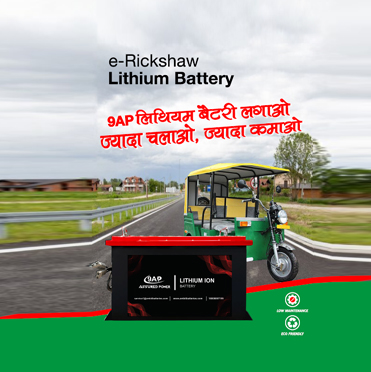
- • E-Rickshaw Lithium Battery
- • Energy Storage Solution (ESS)
- • Battery Energy Storage System (BESS)
- • Telecom Lithium Battery
This broader product capability is important because battery requirements differ significantly between a home inverter, telecom application, EV and commercial energy-storage system.
Application-Specific Battery Solutions
9AP Energy also highlights customized battery configurations.
According to its About page, a significant portion of production is custom-configured, with options to modify parameters such as voltage, capacity, dimensions, connectors and BMS settings according to application requirements.
For B2B customers, OEMs and system integrators, this can be more useful than purchasing a generic off-the-shelf battery.
9AP Energy for Home, Solar and Backup Power
If your requirement is residential or commercial backup, the appropriate solution may be an inverter lithium battery or wall-mounted inverter battery.
For larger renewable-energy applications, the requirement may move toward:
- • Solar energy storage
- • ESS
- • BESS
- • Commercial backup
- • Industrial energy storage
9AP Energy's website positions these solutions as part of a broader energy-storage portfolio rather than treating lithium batteries as a single product category.
This allows customers to evaluate battery technology according to their actual power requirement.
Is Lithium Worth the Higher Initial Cost?
This is one of the most important buying questions.
Lithium batteries normally have a higher upfront price than conventional lead-acid batteries.
But purchase price alone does not determine value.
A better comparison considers:
Total Cost of Ownership = Purchase Cost + Maintenance + Replacement Cost + Energy Losses + Downtime
If a battery lasts longer, requires less maintenance and provides better usable capacity, the economics can become more attractive over its operating life.
For users with frequent power cuts and regular battery cycling, this calculation becomes particularly important.
Lithium Inverter Battery in Delhi: What Should Buyers Consider?
For customers searching for a lithium inverter battery in Delhi, local environmental and installation conditions should also be considered.
Delhi experiences very high summer temperatures, so buyers should pay attention to:
- • Battery operating temperature
- • Thermal protection
- • BMS functionality
- • Installation location
- • Ventilation requirements
- • Enclosure design
- • Warranty
- • Local technical support
Do not select a battery solely because it has the lowest lithium battery price in Delhi.
A reliable battery system should be evaluated for safety, performance, warranty and long-term support.
Frequently Asked Questions
Can I replace my lead acid inverter battery with lithium?
Yes, in many cases. However, the inverter must be compatible with the lithium battery's voltage, charging profile, current requirements and communication requirements where applicable.
Can I use a lithium battery in my existing inverter?
It depends on the inverter. Some existing inverters can work with lithium batteries, while others may require configuration or replacement. Check the exact inverter model before purchasing.
Do lithium batteries work with all inverters?
No. Compatibility depends on voltage, charging parameters, current limits and, for some systems, communication protocols between the battery and inverter.
Is lithium better than tubular battery for an inverter?
Lithium can be a better option for users who prioritize long service life, low maintenance, faster charging, compact design and higher usable capacity. Tubular lead-acid batteries can still be suitable when initial purchase cost is the main consideration.
What lithium battery can replace a 150Ah lead-acid battery?
There is no universal equivalent based only on Ah. The correct lithium battery depends on voltage, usable energy, depth of discharge, inverter efficiency, load and required backup time.
Final Verdict: Should You Switch from Lead Acid to Lithium?
If your current lead-acid inverter battery is approaching the end of its service life, lithium is worth considering.
A properly selected lithium inverter battery can provide a more modern backup solution with lower maintenance, faster charging, longer operating life and compact installation.
But don't buy a lithium battery simply because it has a higher Ah rating or because it is advertised as a replacement.
Check compatibility first.
Your inverter voltage, charging profile, current requirements, BMS and communication system should all be considered before making the switch.
For customers looking for a reliable lithium battery manufacturer in India, 9AP Energy offers solutions across inverter backup, wall-mounted backup, EV mobility, telecom, ESS and BESS applications.
Talk to 9AP Energy Before You Upgrade
If you are planning to replace your lead acid inverter battery with lithium, share your existing inverter model, battery specifications and approximate load with the 9AP Energy team.
The right battery should be selected according to your actual application—not simply by matching the old battery's Ah rating.
9AP Energy / 9AP Power
Sales: 1800 890 6299
Service: 1800 889 7199
Email: support@9apenergy.com | info@9apenergy.com
Address: FF-34, First Floor, Plot No. 9B and 9C, Cross River Mall, CBD Shahdara, New Delhi - 110032, India
Ask 9AP Energy about the right lithium inverter battery for your existing power-backup system.