

Future of Electric Vehicles in India - Role of Lithium Batteries
India is on the brink of one of the biggest transportation revolutions in its history. The future of electric vehicles in India is no longer a distant vision — it is a fast-moving reality reshaping cities, roads, and energy infrastructure across the country.
From electric two-wheelers zipping through Gurugram traffic to electric three-wheelers (e-rickshaws) connecting last-mile commuters in Delhi NCR, the EV wave is unstoppable. And at the heart of this transformation lies one critical technology: the lithium battery.
This guide explores what's driving India's EV revolution, the role of advanced battery technology—specifically LiFePO4 (Lithium Iron Phosphate) batteries—and why choosing the right battery partner could define the success of your EV business in 2025 and beyond.
1. India's EV Market: Where It Stands Today
India is one of the fastest-growing EV markets in the world. In FY 2024–25, total EV sales crossed 1.9 million units, and analysts project this figure to exceed 10 million units annually by 2030, according to the NITI Aayog EV Roadmap 2030.
What's Fueling This Growth?
- Skyrocketing fuel prices making petrol-powered vehicles expensive to operate
- Growing awareness of carbon emission reduction and environmental sustainability
- Expanding EV charging infrastructure in metro cities and Tier-2 towns
- Lower total cost of ownership (TCO) compared to petrol and diesel vehicles
- Aggressive government targets to achieve 30% EV penetration by 2030
The EV market in India is diverse and rapidly evolving. It includes electric two-wheelers, electric three-wheelers and cargo vehicles, electric four-wheelers for personal mobility, and electric buses for public transportation.
India EV Sales Snapshot (FY 2024–25)
| Vehicle Segment | Estimated Annual Units (FY25) |
|---|---|
| Electric Two-Wheelers | ~1.2 Million |
| Electric Three-Wheelers | ~620,000 |
| Electric Four-Wheelers | ~100,000+ |
| Electric Buses & Commercial Vehicles | ~15,000+ |
2. Government Policies Accelerating EV Adoption in India
The Government of India has placed electric vehicles at the center of its clean energy and mobility agenda. Multiple schemes are making EV ownership more affordable while encouraging domestic battery manufacturing.
Key Government Initiatives
- FAME II Scheme (Faster Adoption and Manufacturing of Hybrid & Electric Vehicles): Provides direct subsidies to buyers of electric two-wheelers, three-wheelers, and buses. More than ₹10,000 crore has been allocated.
- PM e-DRIVE Scheme: Introduced to accelerate EV adoption in public transportation, with a focus on electric buses and two-wheelers.
- PLI Scheme for Advanced Chemistry Cells (ACC): Encourages domestic manufacturing of lithium batteries and battery cells to reduce import dependency.
- State EV Policies: States such as Delhi, Maharashtra, Tamil Nadu, and Karnataka offer additional subsidies, road tax exemptions, and registration fee waivers.
- NITI Aayog EV Roadmap 2030: Targets 80% electrification of two-wheelers and three-wheelers and 40% electrification of buses by 2030.
These initiatives are not only encouraging EV adoption but are also shaping the future direction of the industry. Businesses aligned with these policy trends can benefit from both subsidy-driven demand and long-term infrastructure investments.
3. The Battery Technology Powering India's EV Future
No component is more critical to an electric vehicle's performance, safety, and overall ownership cost than its battery. In India's demanding operating environment—characterized by extreme temperatures, dusty roads, frequent short-distance travel, and varied charging habits—battery technology must deliver exceptional reliability.
Today, two primary lithium battery chemistries dominate the Indian EV landscape:
- Lithium-Ion (Li-ion / NMC / NCA): Offers high energy density, lighter weight, and is commonly used in premium electric four-wheelers.
- Lithium Iron Phosphate (LiFePO4): Delivers superior thermal stability, extended cycle life, and enhanced safety, making it the preferred choice for electric two-wheelers, three-wheelers, and energy storage systems.
For commercial EV operators, including e-rickshaw fleets, delivery vehicles, and telecom-powered transportation solutions, LiFePO4 batteries have emerged as the preferred technology due to their outstanding safety standards and long operational lifespan.
Key Battery Performance Metrics for Indian EV Conditions
| Performance Parameter | LiFePO4 (9AP Battery) | Standard Lead Acid Battery |
|---|---|---|
| Cycle Life | 2,000+ Cycles | 300–400 Cycles |
| Depth of Discharge (DoD) | Up to 95% | 50% |
| Thermal Stability | Excellent (No Thermal Runaway) | Moderate |
| Charging Time | Fast (CC-CV Charging) | Slow |
| Weight (Same Capacity) | 60–70% Lighter | Baseline |
| Warranty Period | 60 Months (5 Years) | 12–18 Months |
| Maintenance Required | Zero Maintenance | Regular Water Topping |
| BMS Integration | Smart BMS Included | Not Available |
4. LiFePO4 vs Li-Ion Batteries: Which Is Better for EVs in India?
This is one of the most common questions asked by EV manufacturers, fleet operators, and individual buyers in India. The answer depends on the application, but for most Indian operating conditions, LiFePO4 batteries offer the best combination of safety, longevity, performance, and value.
LiFePO4 Battery Advantages for Indian EVs
- Safe at High Temperatures: India's summer temperatures often exceed 45°C. LiFePO4 chemistry offers exceptional thermal stability and does not experience thermal runaway, making it safer than many conventional lithium-ion variants.
- Long Cycle Life: LiFePO4 batteries can deliver more than 2,000 charge-discharge cycles compared to approximately 500–800 cycles for standard lithium-ion batteries, translating to 6–8 years of daily EV use.
- High Depth of Discharge (DoD): 9AP LiFePO4 batteries support up to 95% DoD, allowing users to utilize nearly all stored energy without compromising battery health.
- Lower Total Cost of Ownership: Although the initial investment is higher than lead-acid batteries, LiFePO4 batteries typically last 5–7 times longer, significantly reducing lifetime ownership costs.
- ICAT Certified & RoHS Compliant: Compliance with Indian automotive safety and environmental standards ensures smooth certification and reliable operation.
For electric rickshaws, delivery e-bikes, and solar-powered EV charging stations, the benefits of LiFePO4 technology are clear. Fleet operators running multiple shifts daily often achieve a return on investment within 18–24 months compared to frequent lead-acid battery replacements.
5. Real-World EV Applications: 2W, 3W, 4W & Commercial Vehicles
India's EV ecosystem spans a wide variety of vehicle categories. Lithium battery technology plays a crucial role in enabling efficiency, reliability, and long-term performance across each segment.
Electric Two-Wheelers (E2W)
India is the world's largest market for electric two-wheelers. Leading brands such as Ola Electric, TVS, Bajaj, and Hero MotoCorp are driving demand for lightweight, high-performance lithium battery packs. Typical battery capacities range from 2 kWh to 5 kWh using 48V or 60V battery architectures.
Electric Three-Wheelers (E3W) & E-Rickshaws
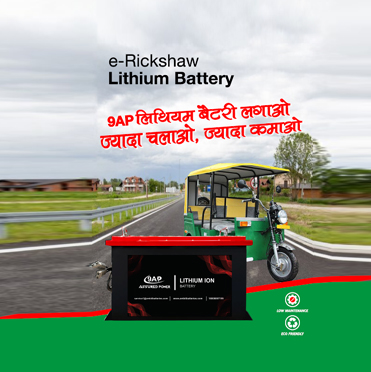
The e-rickshaw sector represents one of India's largest opportunities for LiFePO4 battery adoption. With more than 1.5 million e-rickshaws operating across states such as Delhi NCR, Uttar Pradesh, Bihar, and West Bengal, demand for both replacement batteries and new battery packs continues to grow rapidly.
9AP Assured Power offers advanced 48V and 51.2V LiFePO4 battery packs specifically engineered for e-rickshaw and commercial three-wheeler applications.
Electric Four-Wheelers & Commercial Fleets
Passenger EVs and commercial delivery vehicles are among the fastest-growing categories in urban India. Companies involved in e-commerce and food delivery are increasingly electrifying their fleets, creating strong demand for reliable, high-cycle-life battery systems capable of handling intensive daily operations.
Solar + EV Integration
One of India's most promising emerging opportunities is the integration of solar energy with EV charging infrastructure. LiFePO4 batteries serve as energy storage buffers between rooftop solar systems and EV charging stations, enabling efficient storage of daytime solar generation for nighttime charging.
9AP Assured Power batteries are designed to support solar-powered EV charging applications while meeting stringent industry quality and safety requirements.
6. Smart BMS: The Brain Behind Safe EV Batteries
A Battery Management System (BMS) is the intelligent control unit that protects, monitors, and optimizes battery performance. Without a Smart BMS, even high-quality lithium cells may experience reduced lifespan, lower efficiency, or safety issues.
What Does a Smart BMS Do?
- Monitors cell voltage, temperature, and State of Charge (SoC) in real time
- Prevents overcharging, deep discharge, and short-circuit conditions
- Balances individual cells for consistent battery performance
- Provides battery health diagnostics and performance monitoring
- Supports CC-CV (Constant Current – Constant Voltage) charging for maximum battery life
- Communicates battery data through CAN Bus or Bluetooth-enabled systems
Every 9AP Assured Power LiFePO4 battery pack comes equipped with an integrated Smart BMS as a standard feature. The system is tested extensively for Indian road conditions, temperature variations, vibration levels, and charging behaviors to ensure long-term reliability.
7. Why 9AP Assured Power Is India's Trusted EV Battery Partner
9AP Assured Power, a brand of Ambit Transmission Products Pvt. Ltd., is one of India's leading manufacturers of LiFePO4 battery solutions. The company has established a strong reputation for delivering dependable energy storage systems to some of India's most demanding industries and organizations.
9AP Assured Power: At a Glance
| Specification | Details |
|---|---|
| Cell Technology | LiFePO4 Prismatic Cells |
| Voltage Range | 12.8V / 25.6V / 48V / 51.2V |
| Rated Capacity | 105Ah |
| Depth of Discharge | Up to 95% |
| Battery Protection Rating | IP61 |
| Smart BMS | Integrated on All Units |
| Warranty | 60 Months (5 Years) |
| Certifications | ISO 9001:2015, ISO 14001:2015, ISO 45001:2018, RoHS, ICAT |
| Manufacturing Facilities | Kotdwar & Haridwar, Uttarakhand |
| Notable Clients | Delhi Metro, Microtek, Flipkart, Wipro, PepsiCo |
Our advanced manufacturing facilities in Uttarakhand operate under internationally recognized quality management systems, ensuring every battery pack meets rigorous standards for performance, reliability, and consistency. Whether supplying EV manufacturers, fleet operators, renewable energy projects, or charging infrastructure providers, 9AP Assured Power remains committed to delivering trusted lithium battery solutions built for India's future.
EV Segments Served by 9AP Assured Power
- Electric Three-Wheelers (E-Rickshaws & E-Loaders)
- Electric Two-Wheelers (OEM Supply)
- Electric Commercial & Delivery Vehicles
- Solar + EV Charging Systems
- Telecom Tower EV Applications
- Industrial & Material Handling EVs
Quick Comparison: 9AP LiFePO4 vs Lead Acid
| Parameter | 9AP LiFePO4 Battery | Lead Acid Battery |
|---|---|---|
| Technology | Lithium Iron Phosphate (LiFePO4) | Flooded / VRLA |
| Cycle Life | 2,000+ Cycles | 300–400 Cycles |
| Weight | Approximately 60% Lighter | Heavy |
| Charging Time | 2–4 Hours (CC-CV Charging) | 8–14 Hours |
| Depth of Discharge (DoD) | Up to 95% | Up to 50% |
| Temperature Tolerance | Excellent (Up to 60°C) | Poor (Heat Causes Rapid Degradation) |
| Maintenance | Zero Maintenance | Requires Regular Maintenance |
| Warranty | 60 Months | 12–18 Months |
| Battery Management System (BMS) | Integrated Smart BMS | Not Available |
| Certifications | ICAT, RoHS, ISO Certified | No Standard Certifications |
| 5-Year Cost (Per kWh) | Lower Total Cost of Ownership (TCO) | Higher Due to Frequent Replacements |
8. Frequently Asked Questions (FAQs)
What is the future of electric vehicles in India by 2030?
India's electric vehicle market is expected to surpass 10 million annual vehicle sales by 2030. Government initiatives such as FAME II, PM e-DRIVE, and Production Linked Incentive (PLI) schemes for battery manufacturing, combined with rising fuel prices and declining battery costs, are accelerating adoption. NITI Aayog targets 80% electrification of two-wheelers and three-wheelers by 2030, making the outlook highly promising for the EV industry.
Which lithium battery chemistry is best for electric vehicles in India?
For most Indian EV applications, particularly electric two-wheelers, three-wheelers, and commercial fleets, LiFePO4 (Lithium Iron Phosphate) is considered the preferred battery chemistry. It offers excellent thermal stability, enhanced safety, longer lifespan, up to 95% depth of discharge, and superior performance in India's hot climate conditions.
How long does a lithium EV battery last in Indian road and climate conditions?
A premium-quality LiFePO4 battery such as those manufactured by 9AP Assured Power can deliver more than 2,000 charge-discharge cycles. Under normal operating conditions, this translates into approximately 6–8 years of daily usage for electric rickshaws, delivery vehicles, and commercial EV fleets. The integrated Smart BMS further extends battery life by protecting against overcharging, deep discharge, and temperature fluctuations.
What government subsidies are available for EV batteries in India in 2025?
Several government programs support EV adoption and battery manufacturing in India, including:
- FAME II Scheme – Direct incentives for electric two-wheelers, three-wheelers, and buses.
- PM e-DRIVE Scheme – Supports public transportation electrification.
- PLI Scheme for Advanced Chemistry Cells (ACC) – Encourages domestic lithium battery manufacturing.
- State EV Policies – Additional incentives, tax exemptions, and rebates offered by states such as Delhi, Maharashtra, Karnataka, and Tamil Nadu.
How does 9AP Assured Power support India's EV ecosystem?
9AP Assured Power manufactures ICAT-certified and RoHS-compliant LiFePO4 battery solutions for electric two-wheelers, three-wheelers, commercial delivery vehicles, telecom applications, and solar-integrated EV charging systems. With advanced manufacturing facilities in Kotdwar and Haridwar, ISO-certified quality processes, a 60-month warranty, and Smart BMS technology as standard, 9AP continues to support India's transition toward sustainable mobility.
9. Conclusion: The EV Revolution Needs the Right Battery Partner
The future of electric vehicles in India is brighter than ever. Government support, growing consumer awareness, increasing fuel costs, expanding charging infrastructure, and advancements in battery technology are accelerating the transition toward electric mobility.
However, the performance, reliability, and profitability of every EV ultimately depend on the quality of its battery system. Choosing the right battery technology and manufacturing partner is critical for ensuring long-term operational success.
9AP Assured Power's advanced LiFePO4 battery technology delivers the performance advantages modern EV businesses need, including:
- 2,000+ Charge Cycles
- Up to 95% Depth of Discharge
- Integrated Smart BMS Protection
- 60-Month Warranty
- ICAT & RoHS Certifications
- Reliable Performance in Indian Climate Conditions
Whether you are an EV manufacturer, fleet operator, e-rickshaw owner, solar charging provider, or energy storage integrator, 9AP Assured Power offers dependable battery solutions designed for India's evolving mobility ecosystem.
Power Your EV Business with 9AP Assured Power
India's trusted LiFePO4 battery manufacturer for electric vehicles and energy storage solutions.
Email: support@9apenergy.com | info@9apenergy.com
Toll-Free: 1800 890 6299 | 1800 889 7199
Address: FF-34, First Floor, Cross River Mall, CBD Shahdara, New Delhi – 110032
Website: www.9apenergy.com